Starting a fuel delivery business: the operations half nobody plans
In short
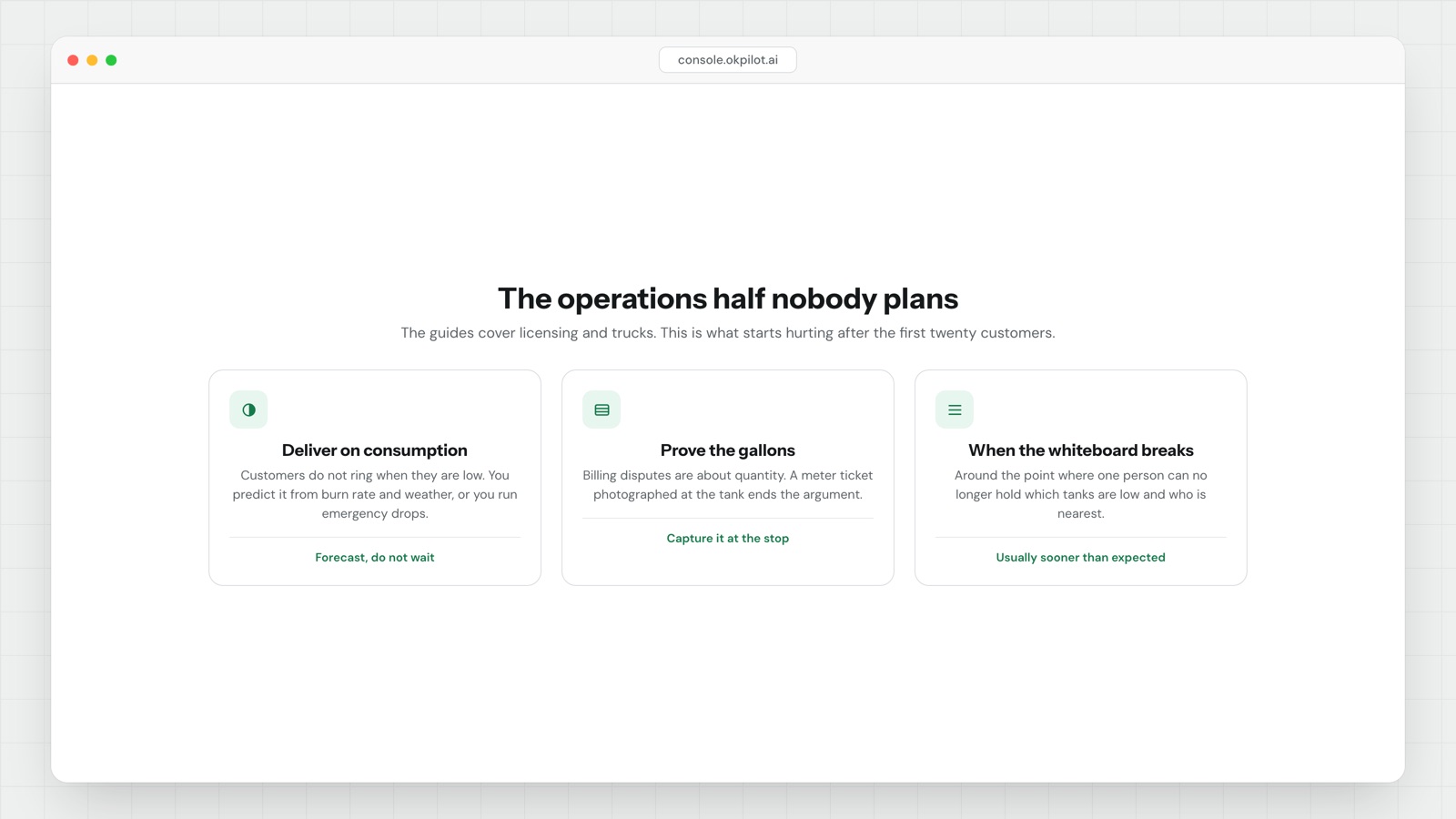
Most advice on how to start a fuel delivery business stops at licensing, trucks and tank storage. The operations half decides whether the business works: you will schedule deliveries by predicted consumption rather than by customer request, you will defend billed gallons with records, and you will outgrow a whiteboard sooner than you expect.
- Capture consumption data from your first delivery. Date, gallons pumped, meter start and end, tank size, tank level. History cannot be reconstructed later, and every forecast you will ever run depends on it.
- Two kinds of customer, two businesses. Will-call customers call you and you deliver. Keep-full customers do not call, and from the moment you sign one, running out is your fault.
- The ticket is the invoice. Gallons disputes are settled by meter readings, timestamps and location, not by memory. If you bill temperature-compensated gallons, the ticket must say so.
- Track gallons per stop and gallons per route hour from week one. Stops per day is the wrong metric in fuel, because the truck runs out of product before it runs out of hours.
- The regulatory side is real and this post does not cover it. Licensing, cargo tank specification, endorsements, metering certification and environmental rules vary by state and by product. Get those from your state authority and an attorney, not a blog post.
The compliance half, pointed at honestly
Nothing below substitutes for the licensing work, and any guide implying otherwise is selling you something. At minimum you will deal with:
- Federal motor carrier registration, a USDOT number, and the driver qualification files that come with it.
- A CDL with the tank vehicle endorsement plus a hazardous materials endorsement, which carries its own security threat assessment.
- Cargo tank specification and periodic tank testing. Which specification depends on what you haul; propane is not the same answer as heating oil or diesel.
- Product-specific safety codes. For LP-gas, the NFPA standards your state has adopted, plus typically a state LP-gas board or fire marshal license with its own technician certifications.
- Weights and measures. Your truck meter is a commercial measuring device, and it has to be certified and sealed.
- Insurance written for what you actually do, including pollution and environmental liability, which commercial auto does not cover.
Get the specifics from your state's authority and a transportation attorney. Do not take a number off a blog, this one included. What follows assumes that work is done.
What guides on how to start a fuel delivery business leave out
The first twenty customers are easy, and that is the trap. They call when they want fuel, you write them on a pad, you deliver tomorrow. Nothing about it is hard, and nothing about it teaches you the business.
What it does not teach you is that the model inverts. A will-call customer is a dispatch problem: a request arrives, you fulfill it. A keep-full customer is a forecasting problem: nobody asks for anything, and you have to know when to go.
That inversion happens quietly, because keep-full is what customers prefer and what makes revenue predictable. Three months in you have a handful of automatic accounts, no system to serve them, and a no-heat call on the coldest Sunday of the season.
So answer this before you sign the first keep-full contract: on what basis will I decide that this tank needs a delivery next Thursday? If the answer is "I will remember", your ceiling is a few dozen accounts and one bad week.
Scheduling by consumption, not by request
For heating products, consumption tracks the weather, and the standard method is heating degree days: one degree day is the gap between a 65°F base and the day's mean temperature. The per-customer burn rate, the K-factor, falls out of your own delivery history:
K-factor      = degree days since last fill ÷ gallons delivered
daily burn    = today's degree days ÷ K-factor
days to floor = gallons above your reserve floor ÷ daily burn
This is why data capture matters from day one. K-factor needs two consecutive fills with an accurate gallon count and a known date, and nothing recovers that if you did not write it down. A fleet with three seasons of clean history can schedule a territory weeks ahead; a fleet with a shoebox of carbon copies cannot, whatever it buys.
Two cautions before you build anything:
- Degree days only explain the heating load. Summer consumption is hot water, cooking and drying: a flat baseline in gallons per day. Treating it as a weather problem produces nonsense in July.
- The K-factor is a property of a household, not a house. A new tenant, a baby, a pool heater or a shop heater on the same tank makes a long-trusted figure wrong overnight. Recompute on every fill, and look at any account that moves more than about 15%.
Tank monitors are the other half, worth buying selectively: large tanks, commercial accounts, generators, vacation properties, and anyone who has surprised you before. They are not a scheduling system. A monitor tells you a tank is low; it does not tell you today is the day to drive to that side of the county.
Proof of delivery when the argument is about gallons
Parcel disputes are about whether something arrived. Fuel disputes are about how much arrived, and they come attached to an invoice the customer is refusing to pay. A ticket that survives that argument carries:
| Field | Why it settles the dispute |
|---|---|
| Meter start and end reading | The gallons are a difference of two numbers, not an assertion |
| Gross and net gallons | If you bill temperature-compensated gallons, show both and name the basis |
| Timestamp and GPS location | Proves the drop happened at that tank at that time |
| Tank level before and after | Catches the "you only put in half of it" claim |
| Photo of the meter at completion | The highest-value attachment on the ticket |
| Price per gallon applied that day | Most price disputes are actually date disputes |
| Driver identity, and a signature if anyone is there | Many fuel drops are unattended, so a signature often does not exist |
Unattended delivery is the structural difference from most delivery businesses: there is often nobody to sign, which makes the automatic evidence — location, timestamp, photo — your only record. The general case is covered in electronic proof of delivery; for fuel, the meter photo does the work.
One more thing nobody mentions: keep meter calibration certificates with the same care as the tickets. A customer disputing volume will eventually ask whether your meter is accurate, and the answer has to be a document.
When the whiteboard stops working
A whiteboard is a good system: visible, instant, everybody reads it. Its limit is not that it is low-tech, but that it holds one day and one writer. Each of these five triggers means it has stopped being enough; any two together mean it stopped a while ago:
- A second truck. That is a load allocation decision every morning: who takes which gallons, in which zone.
- A second person changing the plan. The moment a dispatcher and an owner both reorder stops, the board is out of date for whoever looks at it second.
- The first keep-full account. You now own a forecast, and a forecast has to live somewhere a person is not.
- A billing dispute you could not settle from your records. That is not a paperwork problem; it is a measurement problem, and it recurs.
- "When is my delivery?" asked of someone who has to go and find out. If the answer needs a call to the driver, you do not have status.
What replaces it is less dramatic than vendors suggest: a place where the day's stop list lives and updates for everyone, a driver app that captures the ticket fields above without extra typing, and a tracking link so customers stop calling to ask. Route optimization matters less than you would think, because a dense territory with sensible zone days beats a clever route order on a scattered one. That trade-off is covered in route planner versus dispatch software.
Where delivery management software earns its place is the handoff between forecast and road: turning a stop list into assigned runs, proving each drop, telling the customer where the truck is. OkPilot does that part, with setup in about 48 hours, which matters in a first season. It will not forecast your tanks. That model is yours to build, out of the delivery history you started recording on day one.
See OkPilot running your own operation
A live walkthrough with a real person, configured to your jobs on the call. About ten minutes. Setup takes around 48 hours.