Electronic proof of delivery: what it actually proves
In short
Electronic proof of delivery is evidence that a job was completed — a photo, a signature, a scanned barcode or a code entered on site — captured on a phone at the moment of handover, with the time and location attached. It records what happened; it does not stop a delivery failing.
- Four things are worth capturing: a photo, a signature or code, time and place, and who did it. Each covers a different kind of argument.
- A one-time code sent to the customer is stronger than a signature, because a signature only proves that a hand moved.
- Time and place should come from the device automatically, not be typed in by the driver at the end of the shift.
- It pays in three places, in roughly this order: disputes, compliance, and knowing what the day actually looked like.
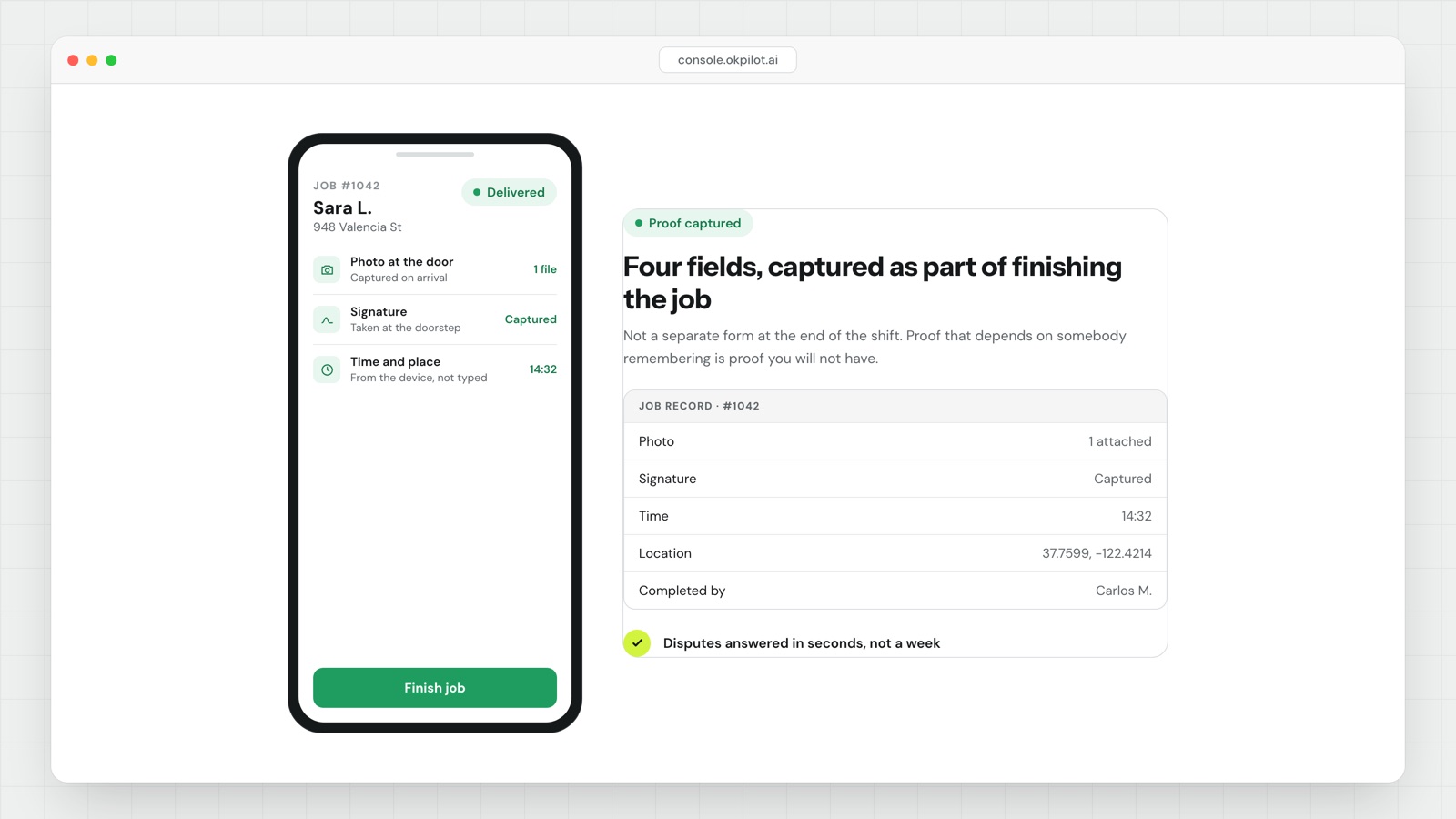
- Proof that depends on a driver remembering to do something extra is proof you will not have on the day you need it. Capture has to be part of finishing the job.
- It is a record, not a remedy. It will not get the gate open, and it will not make a failed delivery succeed.
A signature on a paper sheet proves almost nothing
Electronic proof of delivery is evidence that a job was actually completed — a photo, a signature, a scanned barcode or a code entered on site — captured on a phone at the moment of handover, with the time and location attached. It replaces the paper sheet that used to come back to the depot three days later, smudged and unreadable.
The paper version failed in a specific way. A scrawl on a delivery note tells you somebody signed something. It does not tell you who, where they were standing, what condition the goods were in, or what time it happened. When a customer calls two weeks later to say the order never arrived, the sheet in the filing cabinet settles nothing.
The four things worth capturing
Most systems collect some combination of these. The useful ones collect all four, because each covers a different kind of argument.
- A photo. The parcel on the doorstep, the installed unit, the meter reading. This is what resolves "it arrived damaged" and "nothing was left."
- A signature or a code. Someone accepted the goods. A one-time code sent to the customer is stronger than a signature, because a signature only proves that a hand moved.
- Time and place. Taken automatically from the device — not typed in by the driver at the end of the shift.
- Who did it. The person, not just the vehicle.
Four fields, captured as part of finishing the job rather than as a separate form someone fills in later. That last part matters more than the feature list. Proof that depends on a driver remembering to do something extra is proof you will not have on the day you need it.
Where it actually pays
Three places, in roughly this order.
Disputes. A customer claims non-delivery. You have a photo, a timestamp and a location. The conversation takes thirty seconds instead of a week, and you do not refund an order that was delivered.
Compliance. Some deliveries have rules attached — a prescription that needs an ID check, a sample with a temperature window, an installation that needs a certificate. Pharmacy delivery is the clearest case: the proof is not a nicety, it is what makes the delivery legal.
Knowing what happened. The quiet one. When a route goes wrong, the useful question is not "was it delivered" but "what did the day actually look like." Timestamps across a route show you the stop that ran long, and usually hint at why.
What it does not fix
Proof capture is a record, not a remedy. It will not make a failed delivery succeed, it will not get the gate open, and it will not tell the driver that the customer is out. That is a different problem, and no amount of evidence solves it.
What it does is stop the same argument happening twice. The evidence exists, it is attached to the job, and anyone who needs it can find it without phoning the driver.
If your proof lives in a WhatsApp thread, you do not have proof. You have a group chat.
If you are running more than a handful of jobs a day and currently settling disputes from memory, that is the thing to fix before routing and before scheduling.
See OkPilot running your own operation
A live walkthrough with a real person, configured to your jobs on the call. About ten minutes. Setup takes around 48 hours.