Route planner or dispatch software: which one you actually need
In short
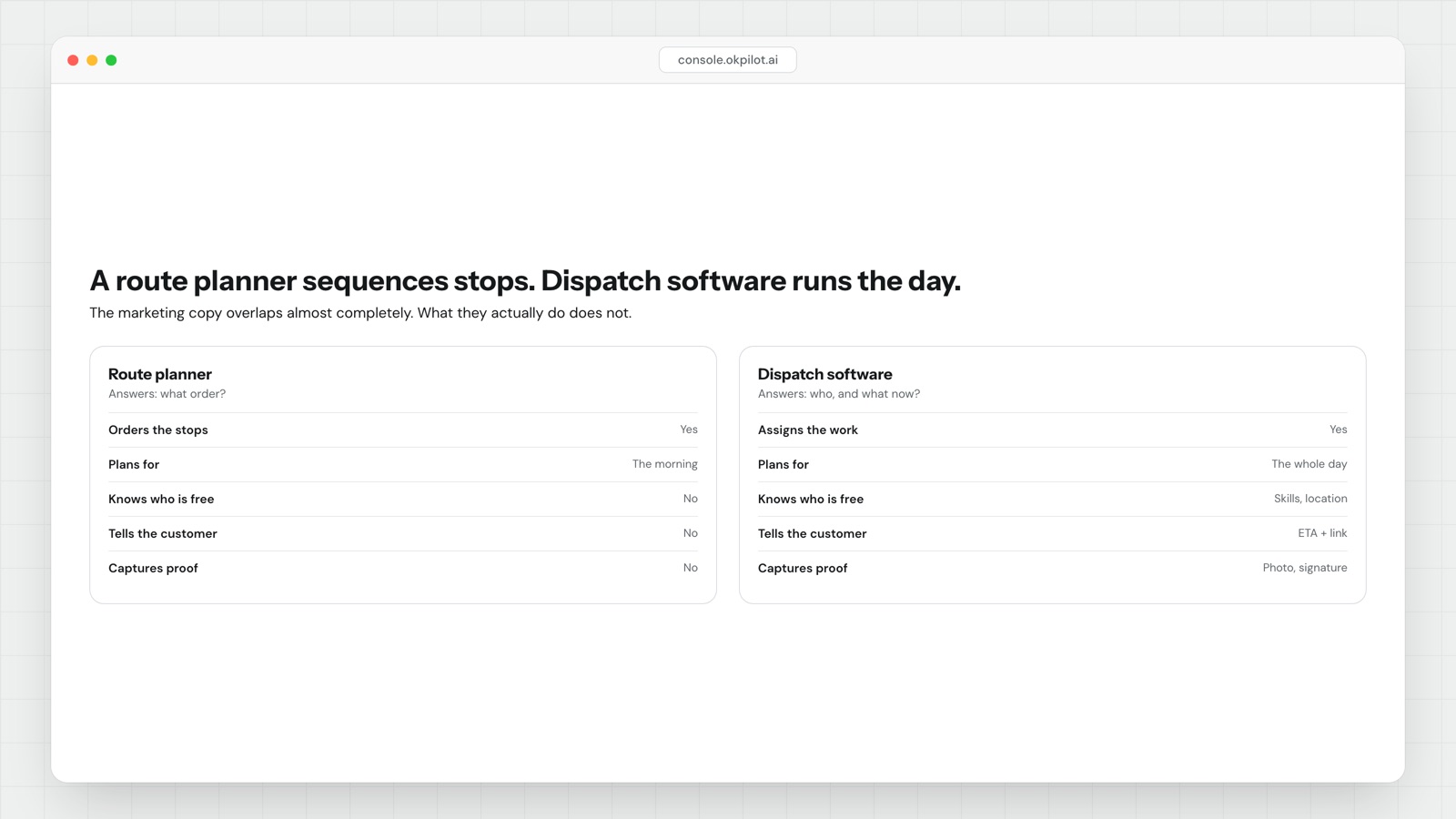
A route planner takes a list of addresses and puts them in a sensible order. Dispatch software decides who is going, reassigns work when the day changes, tells the customer, and records what happened. The overlap in marketing copy is almost total; the overlap in what they do is not.
| Route planner | Dispatch software | |
|---|---|---|
| Core job | Order the stops | Assign and manage the work |
| Plans for | The morning | The whole day, as it changes |
| Knows about people | Usually not | Who is free, skilled, closest |
| Customer contact | Rarely | ETA and tracking link |
| Proof of completion | No | Yes |
- Three questions decide it: does the plan survive the morning, does anyone outside the team need to know where the job is, and does a finished job need to leave a record.
- If the answer to all three is no, a route planner is genuinely enough and you should not pay for more.
- If a typical day involves two reschedules, a sick driver and an urgent job at 11am, the plan is not the product — the replanning is.
- A route planner has no live status. The moment somebody rings to ask where the job is, you need one.
- The common failure is buying a route planner and running the real operation in WhatsApp beside it. That works at five people and stops working at fifteen, usually not gradually.
They solve different halves of the problem
A route planner takes a list of addresses and puts them in a sensible order. Dispatch software decides who is going, reassigns work when the day changes, tells the customer, and records what happened.
The overlap in marketing copy is almost total. The overlap in what they do is not.
| Route planner | Dispatch software | |
|---|---|---|
| Core job | Order the stops | Assign and manage the work |
| Plans for | The morning | The whole day, as it changes |
| Knows about people | Usually not | Who is free, skilled, closest |
| Customer contact | Rarely | ETA and tracking link |
| Proof of completion | No | Yes |
How to tell which you need
Three questions. If you answer "no" to all three, a route planner is genuinely enough and you should not pay for more.
Does the plan survive the morning? If your day usually runs as planned, ordering stops well is most of the value. If a typical day involves two reschedules, a sick driver and an urgent job at 11am, the plan is not the product — the replanning is.
Does anyone need to know where the job is? A customer, a client, an office. The moment somebody rings to ask, you need live status, and a route planner does not have one.
Does a finished job need to leave a record? If a disputed job costs you money, you need proof capture. A route planner finishes when the driver arrives.
Where teams go wrong
They buy a route planner because the demo is satisfying — you paste addresses in and lines appear on a map — then spend the next year running the actual operation in WhatsApp alongside it.
That combination works at five people. At fifteen it stops working, usually not gradually. The symptom is a dispatcher who cannot take a day off because nobody else knows what is in their head.
The other direction happens too. A team of three with predictable rounds buys a full dispatch platform, uses the routing and nothing else, and resents the bill. That is a real outcome and worth naming.
The honest line
If your work is predictable and small, a route planner is the right purchase. If your day changes after it starts, or anyone outside your team needs to know what is happening, routing is the part of the problem that was already solved — and buying more of it will not help.
The question is not "can it plan a route." Everything can plan a route. The question is what happens at 11am.
OkPilot is the second kind: assignment, live status, customer ETA and proof, with the routing included rather than sold as the headline.
See OkPilot running your own operation
A live walkthrough with a real person, configured to your jobs on the call. About ten minutes. Setup takes around 48 hours.