Blog
 Pool and home service
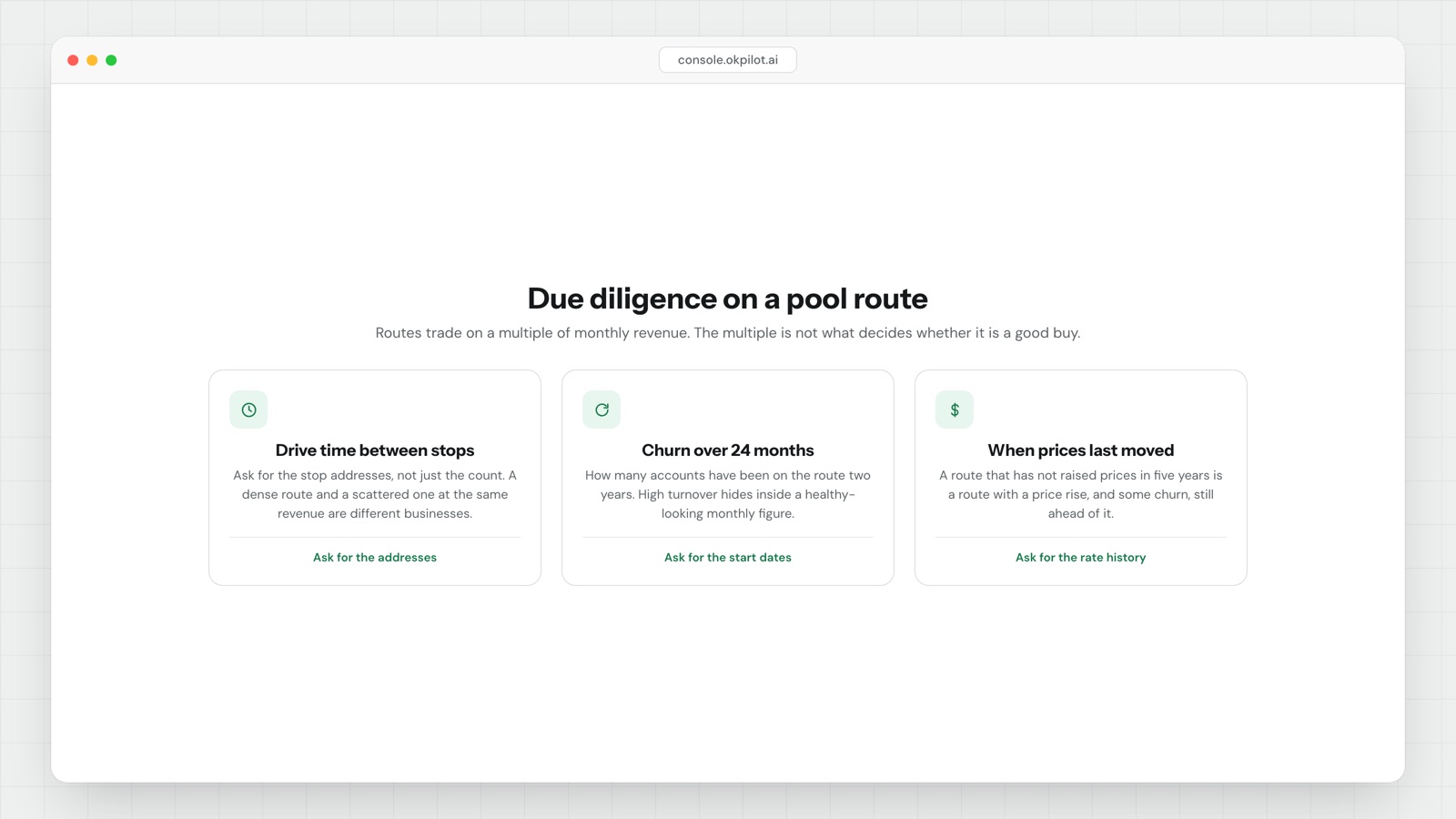
Buying a pool service route: what to check in the job data first
Pool routes are priced on a multiple of monthly billing, but drive time between stops and customer churn decide whether the route is worth buying, and both are in data you can ask the seller for.
 Customer experience
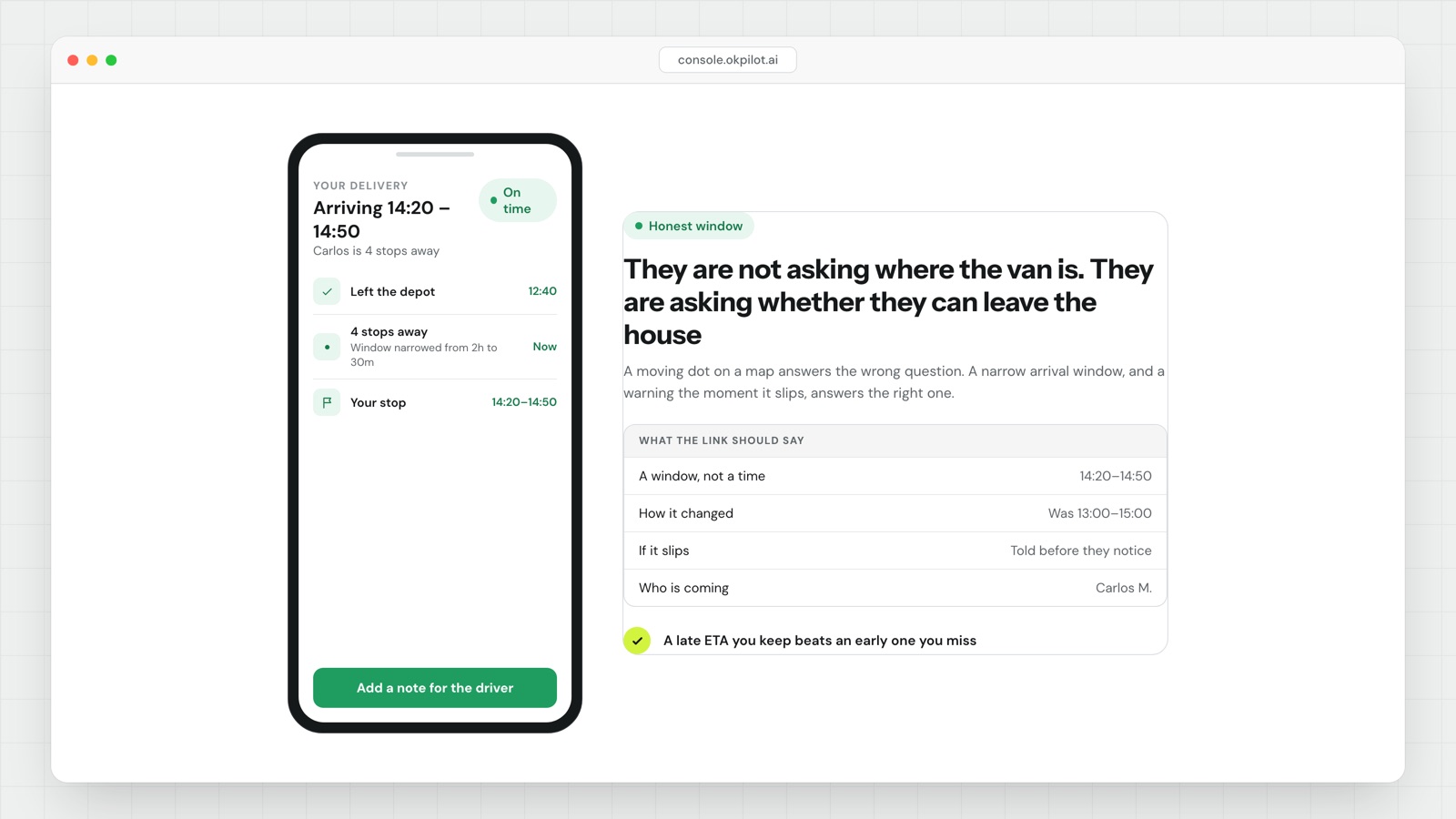
What the customer actually wants from a tracking link
Customers do not want a moving dot on a map, they want to know whether they can leave the house, which means a narrow delivery window you can hit and a warning when it slips.
 Pool and home service
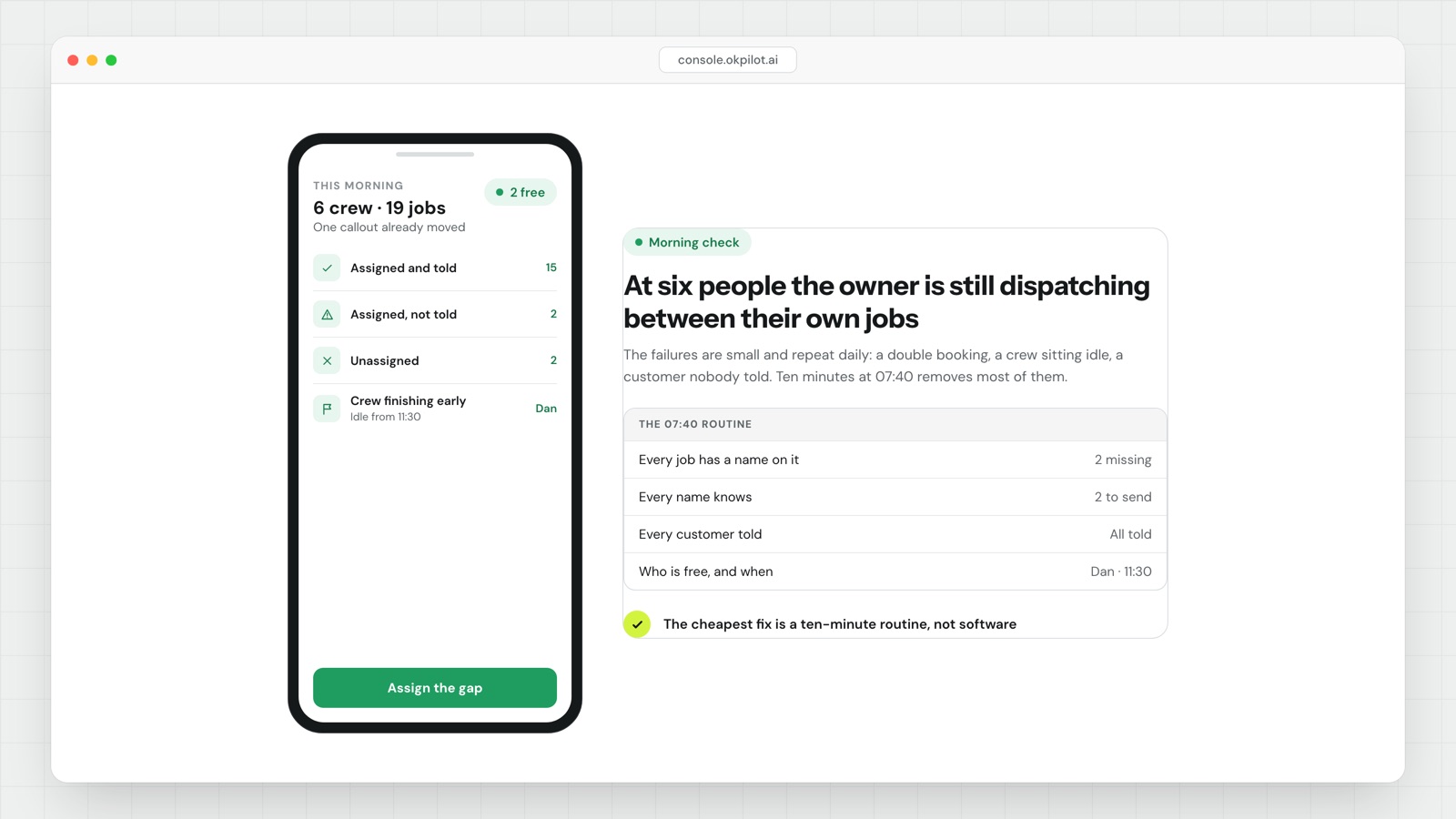
Dispatching a home-service crew of six
At six people the owner is still dispatching from a phone between their own jobs, and three specific things go wrong: here is the night-before and morning routine that fixes most of them.
 Fuel and propane
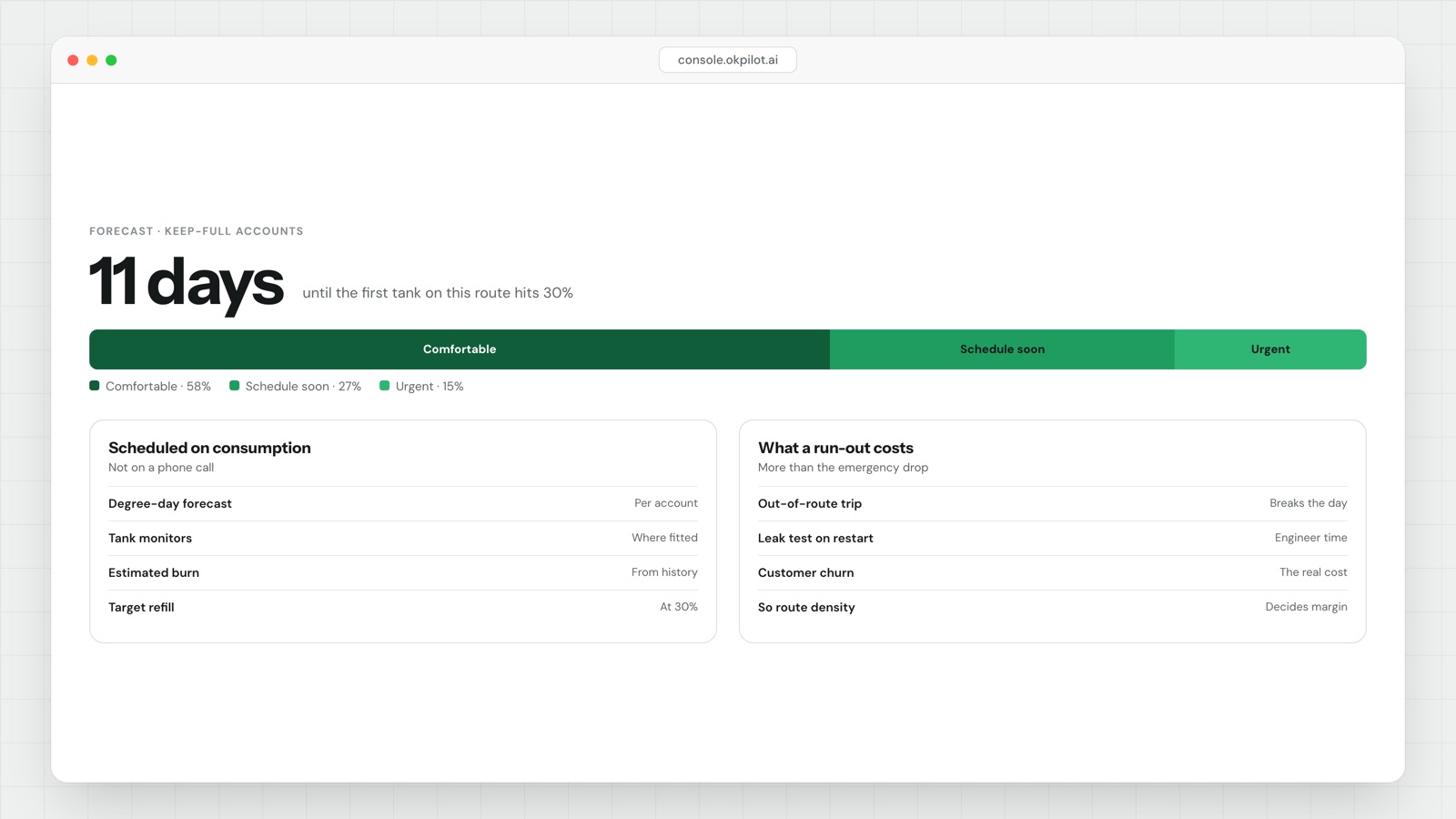
How propane delivery scheduling actually works
Propane and heating oil are delivered on predicted consumption, not on request — here is the degree-day arithmetic that decides when a truck goes out, and why route density matters more in fuel than anywhere else.
 Routing and last mile
Sales route planning and the beat plan
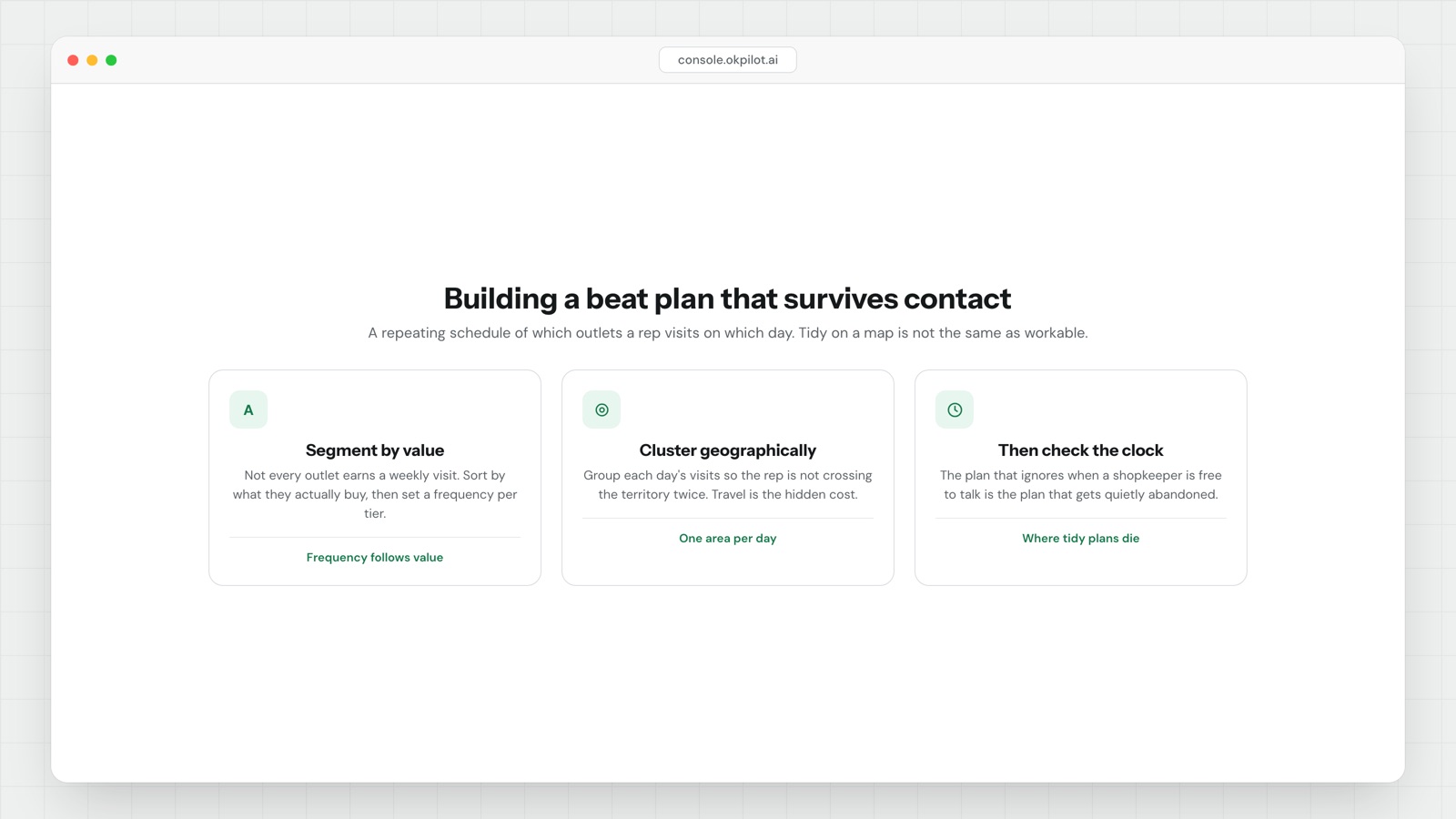
A beat plan is a repeating schedule of which outlets a rep visits on which day. Here is how to set visit frequency from sell-through, cluster the geography, and check whether the plan is arithmetically possible.
 Fuel and propane
Starting a fuel delivery business: the operations half nobody plans
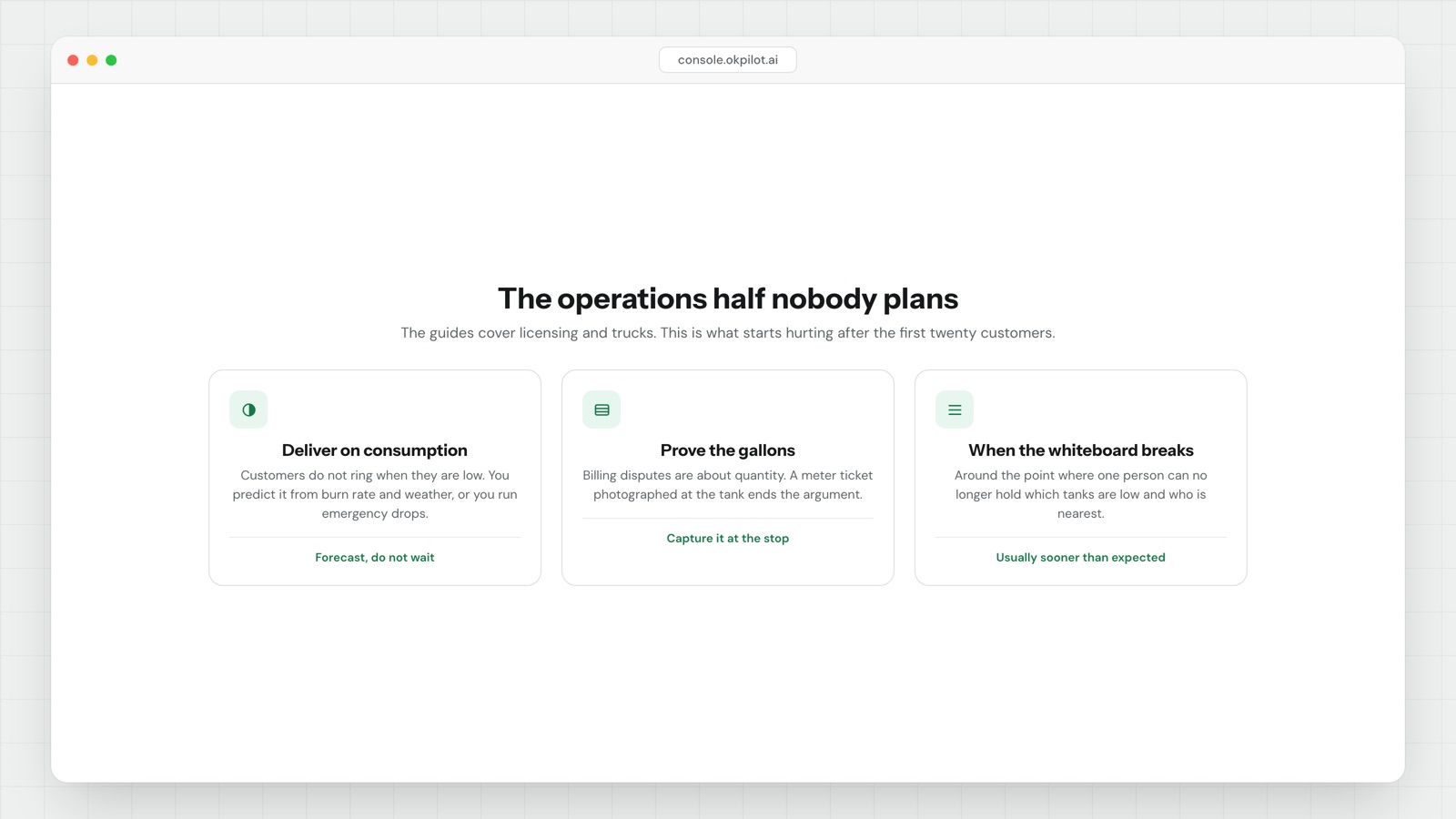
Licensing and trucks are the half of a fuel delivery startup that every guide covers; this is the other half, from scheduling by consumption to the day the whiteboard stops working.
 Pharmacy and medical
Chain of custody for medical specimens, stop by stop
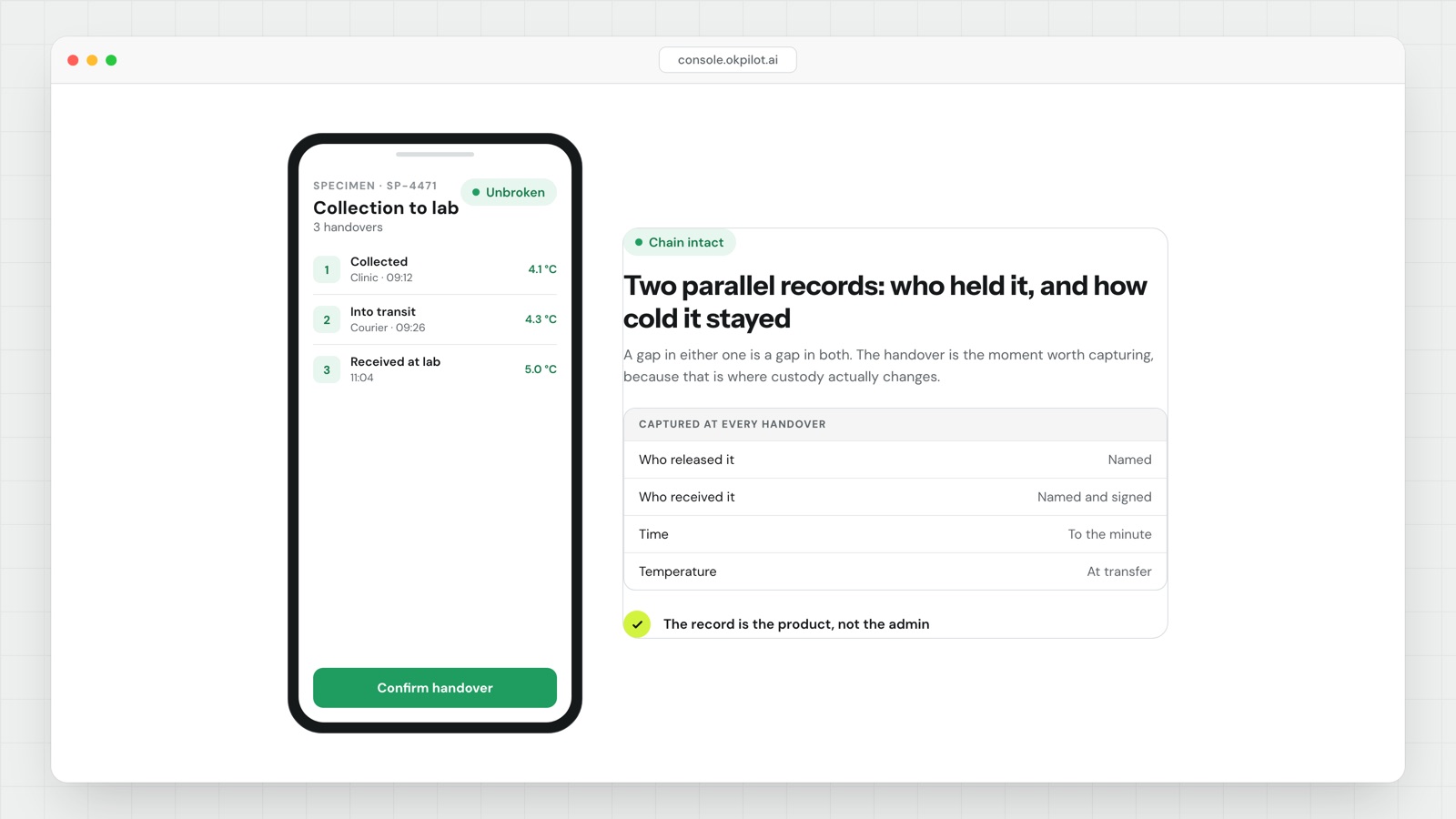
A specimen's chain of custody is two parallel records — who held it and what temperature it sat at — and here is exactly what has to be captured at each handover from collection to accessioning.
 Customer experience
How long a delivery exception lasts, and what to do meanwhile
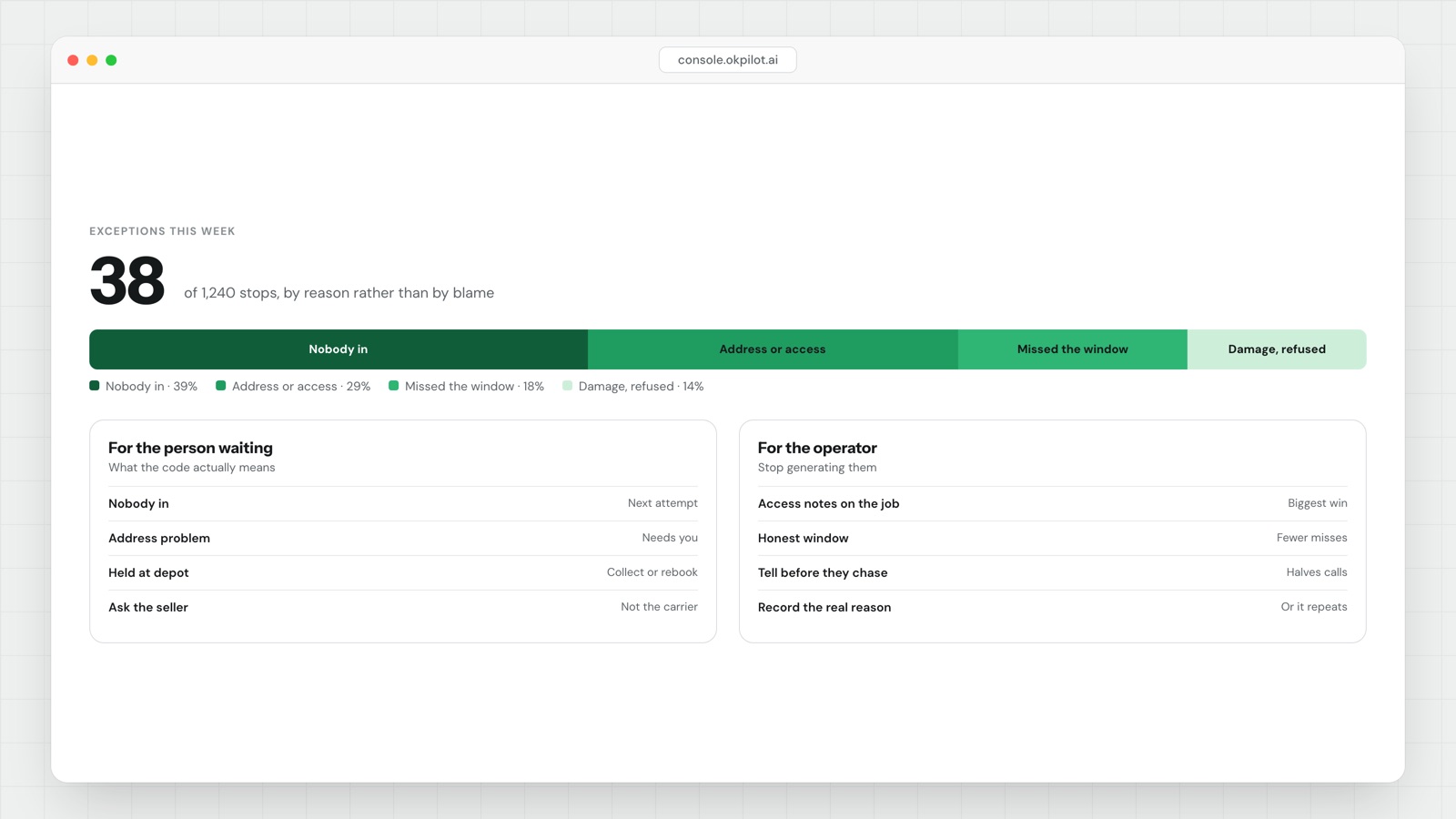
A delivery exception usually clears on the next scan, but the honest answer depends entirely on the reason — here is what each reason means for a waiting customer, and how an operator stops generating them.
 Choosing software
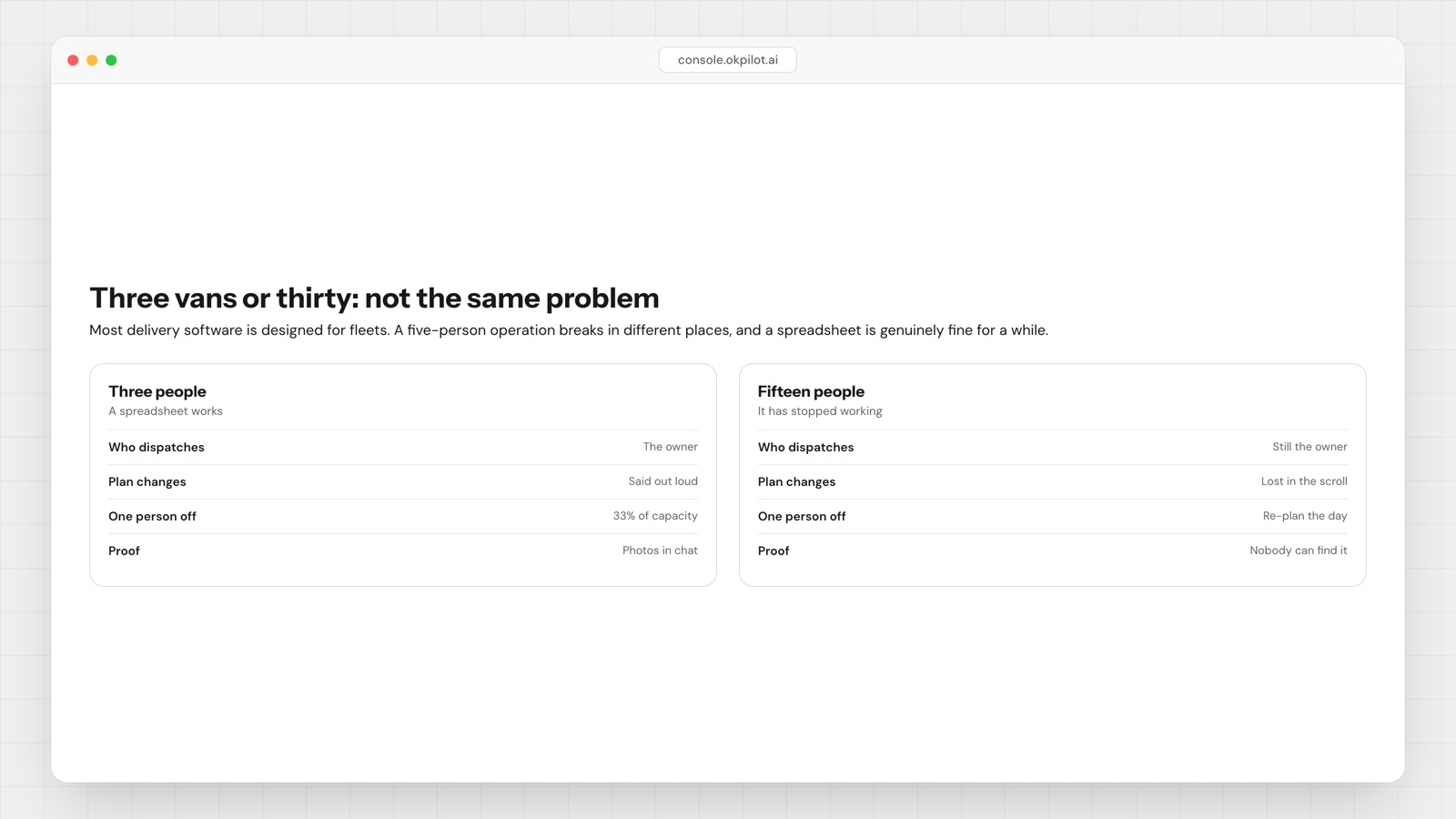
Delivery management when the team is five people, not fifty
A spreadsheet is genuinely fine for a three-van operation — here are the specific thresholds where it stops being fine, and what to check before paying for delivery software built for fleets.
 Dispatch and scheduling
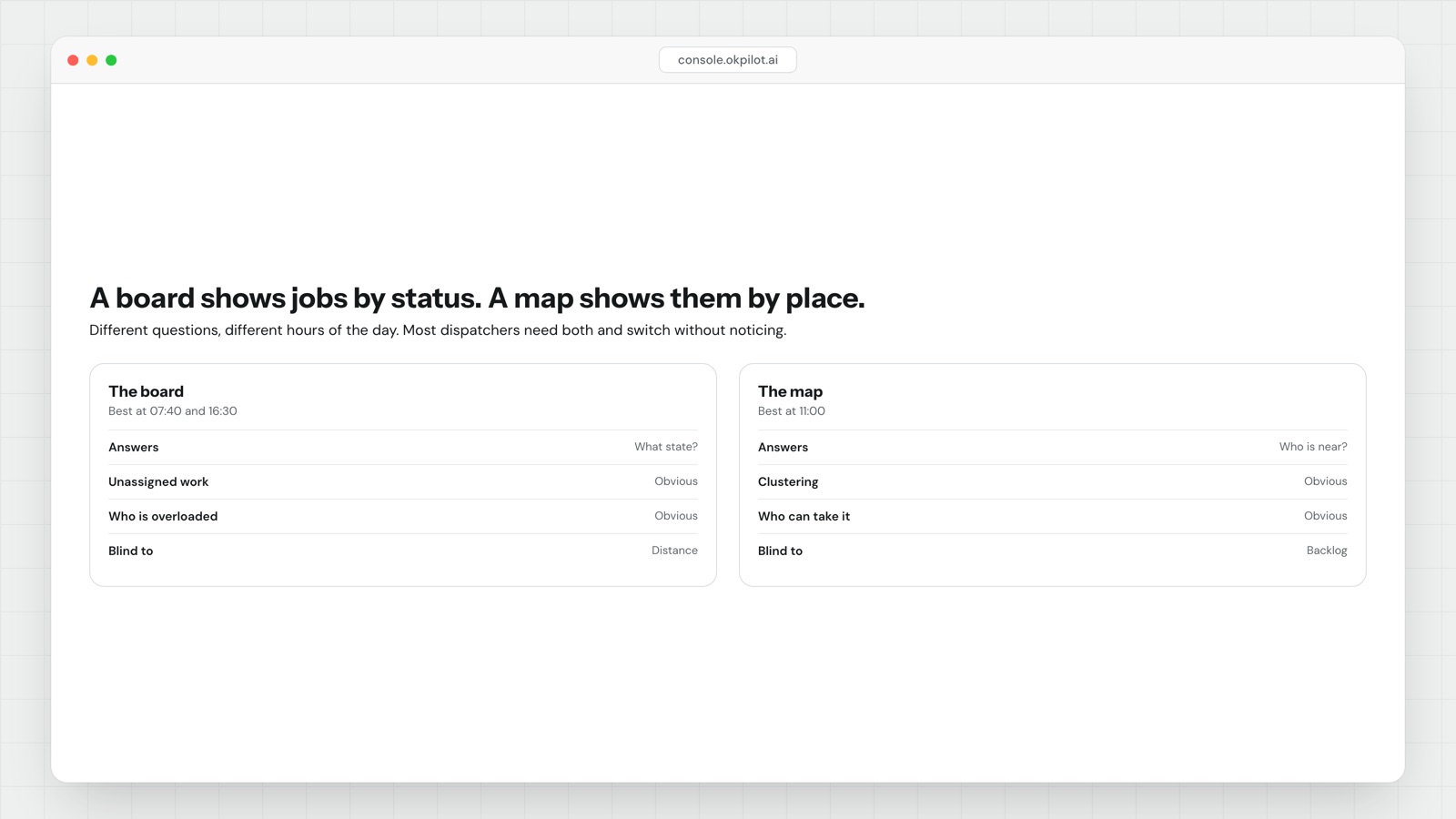
Dispatch board or dispatch map: which view a dispatcher actually needs
A dispatch board shows jobs by status and a dispatch map shows them by place — they answer different questions, and a dispatcher needs each one at different hours of the day.
 Dispatch and scheduling
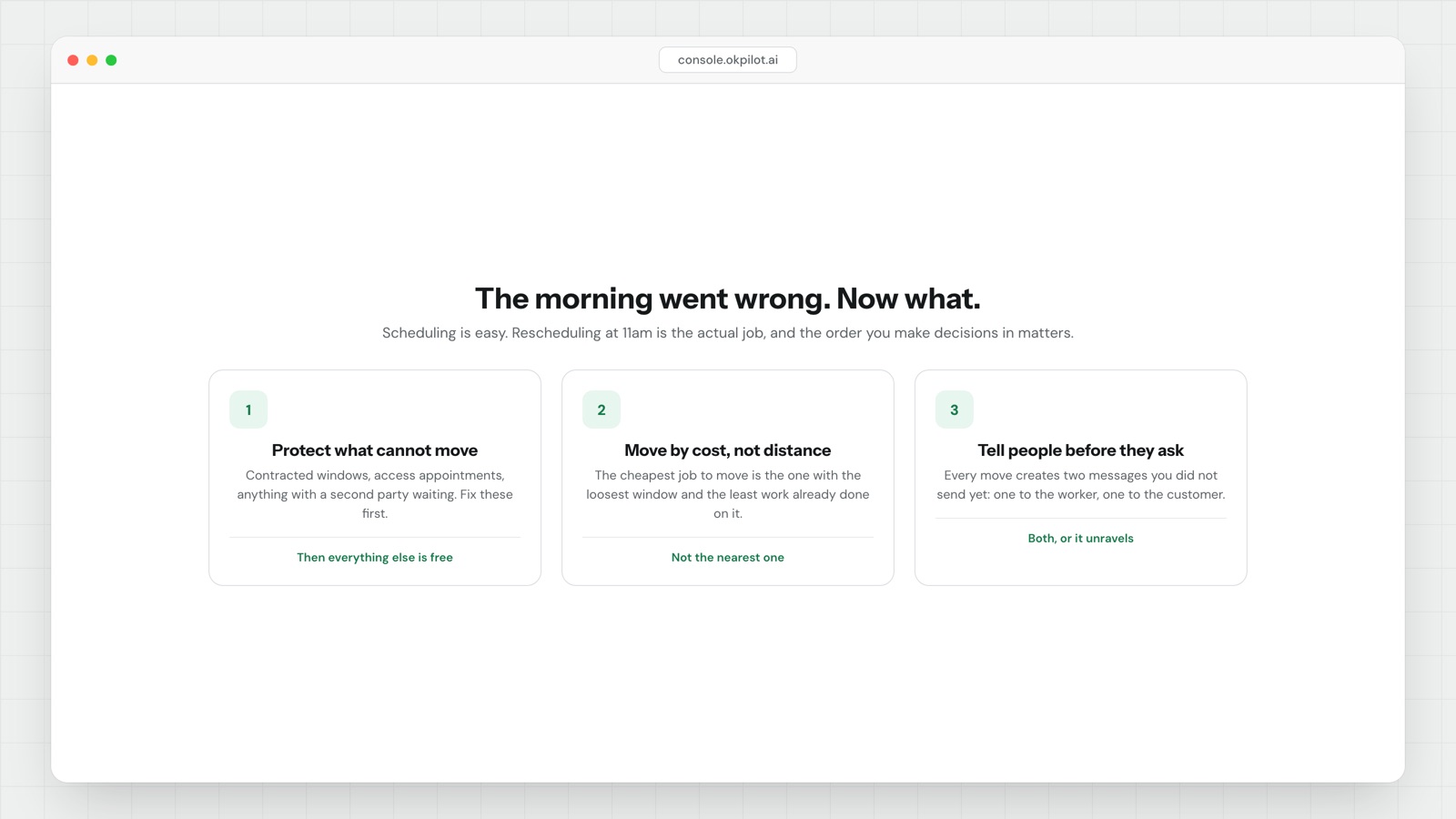
Dispatch scheduling when the day stops going to plan
Building a dispatch schedule is the easy part; rebuilding it at 11am with a van down and two reschedules is the actual job — here is the order to make those decisions in.
 Proof and compliance
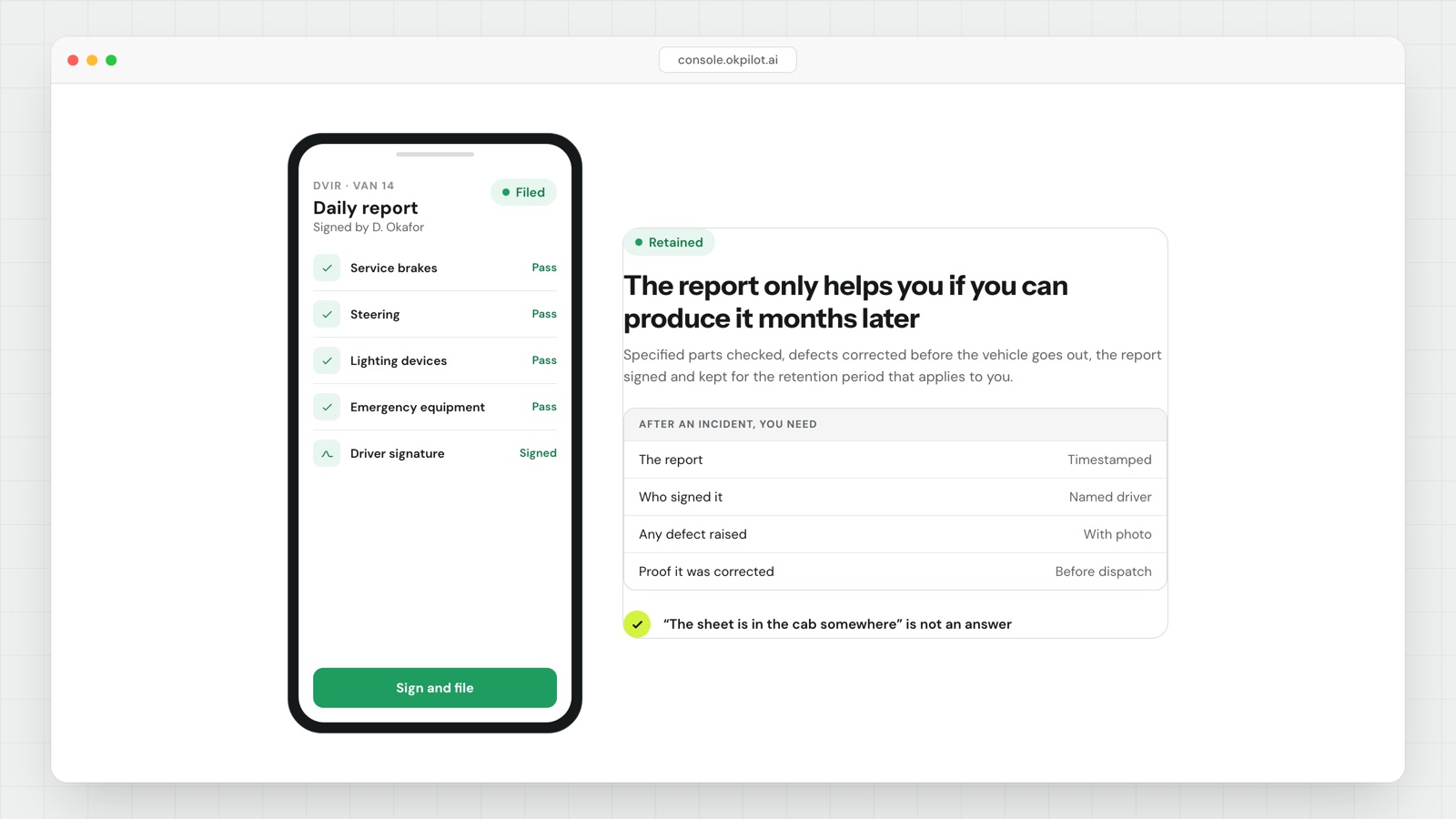
What a DVIR must contain, and how long you have to keep it
A driver vehicle inspection report has to cover named vehicle parts, carry the driver's signature, and be kept for a defined period — here is what the FMCSA rules actually require and what they do not.
 Routing and last mile
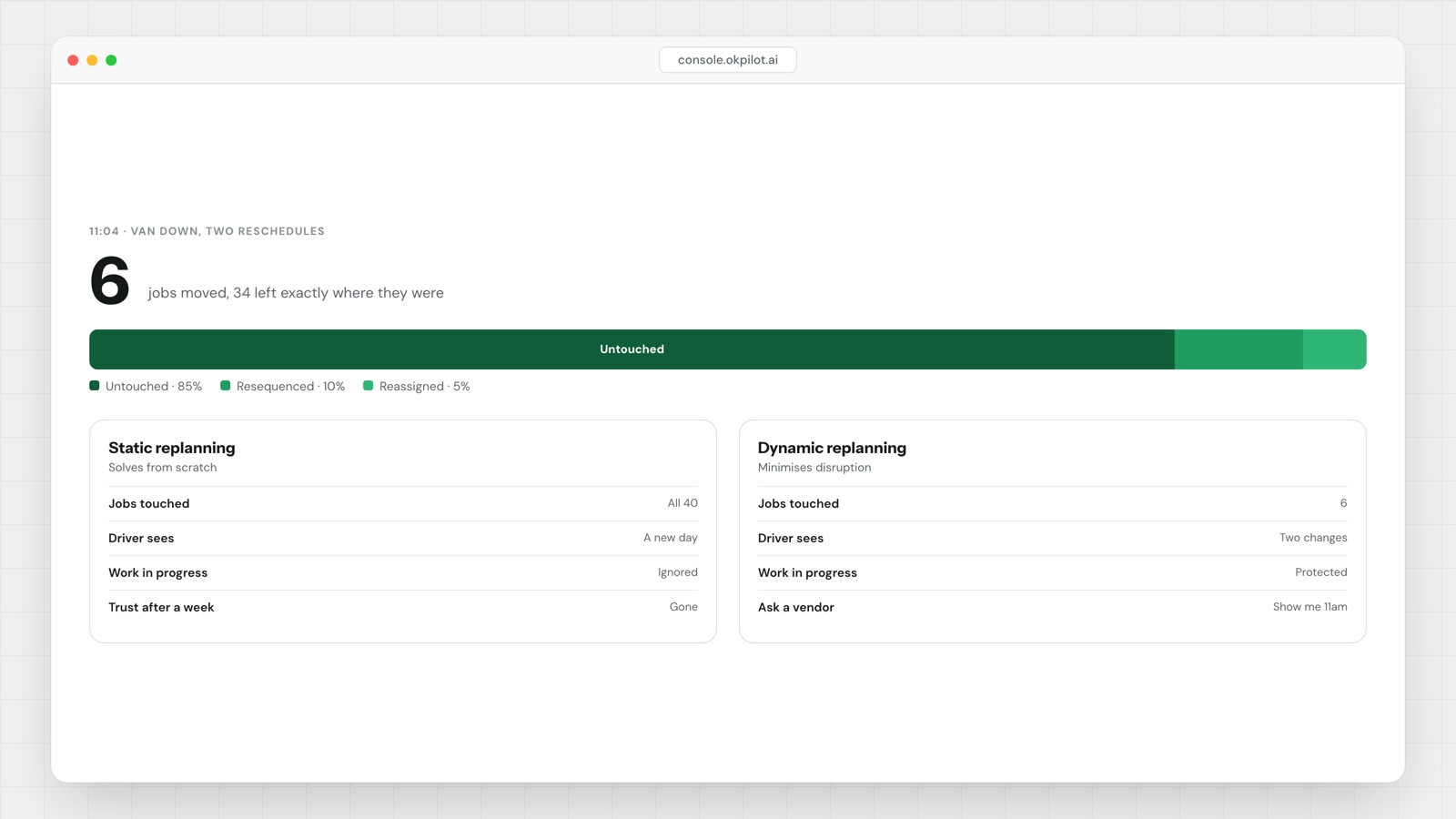
Dynamic route optimization: replanning after the day has started
Static route planning solves the morning. Dynamic route optimization has to solve 11am without churning the work a driver has already half finished, and here is how to tell whether a vendor can actually do that.
 Grocery and retail
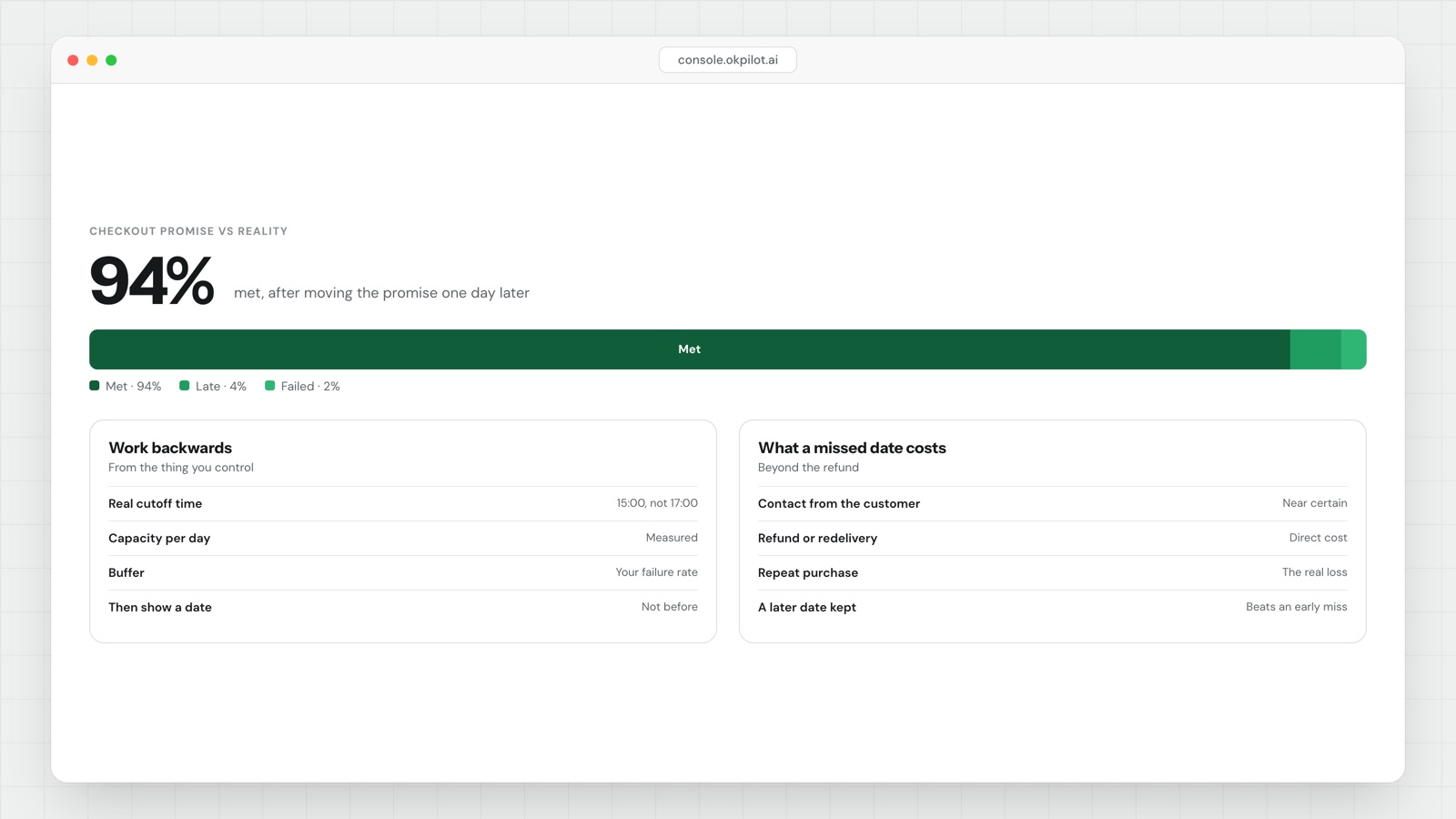
Delivery promises on a product page you can actually keep
The date on a product page is a promise made before anyone knows whether there is capacity to keep it — here is how to build it backwards from real cutoffs, real capacity and a buffer sized to your own lateness.
 Routing and last mile
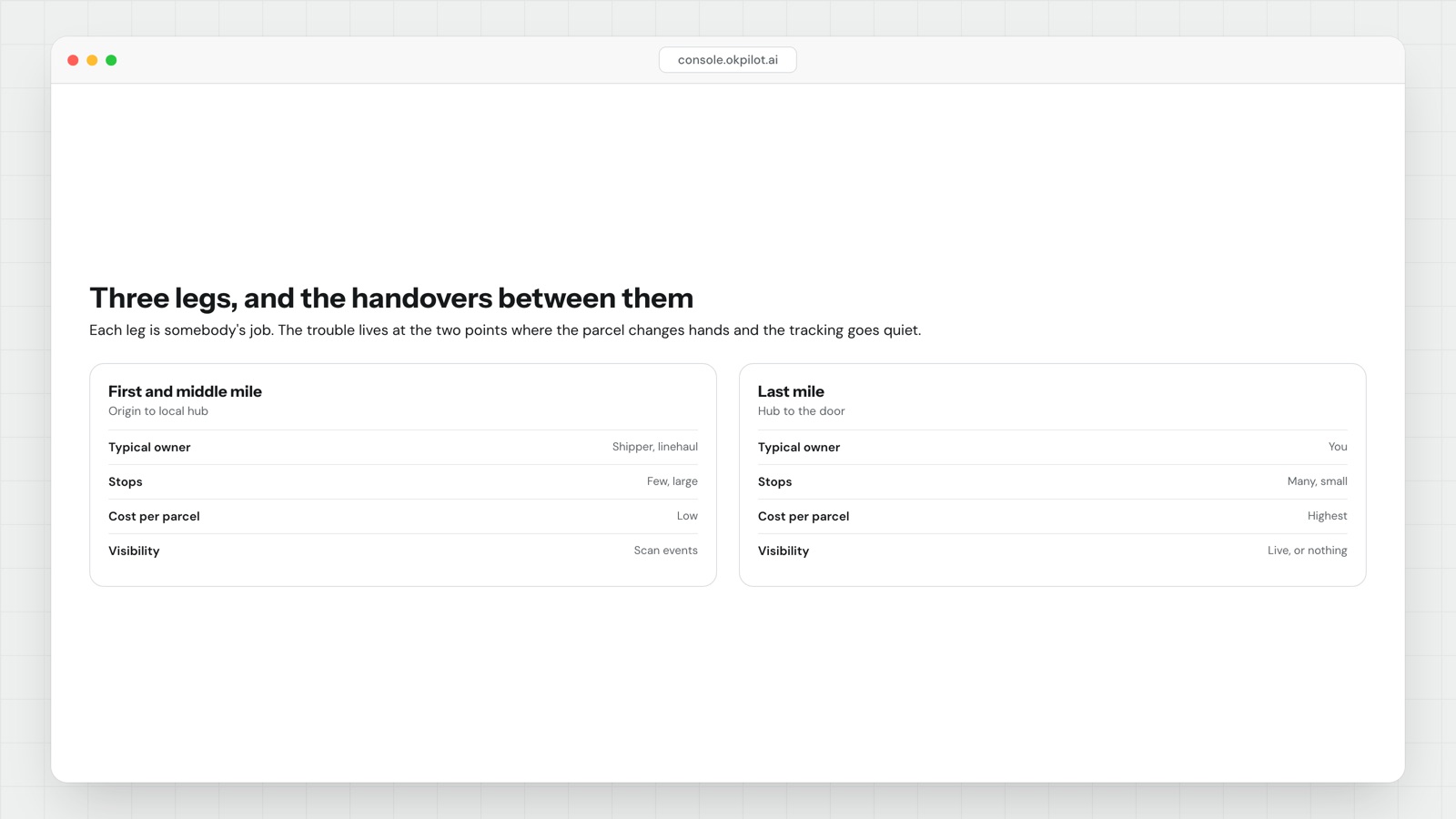
First mile, middle mile, last mile: who owns which part
A plain definition of first mile, middle mile and last mile, plus what specifically breaks at each of the four handovers where liability, visibility and blame change hands.
 Pharmacy and medical
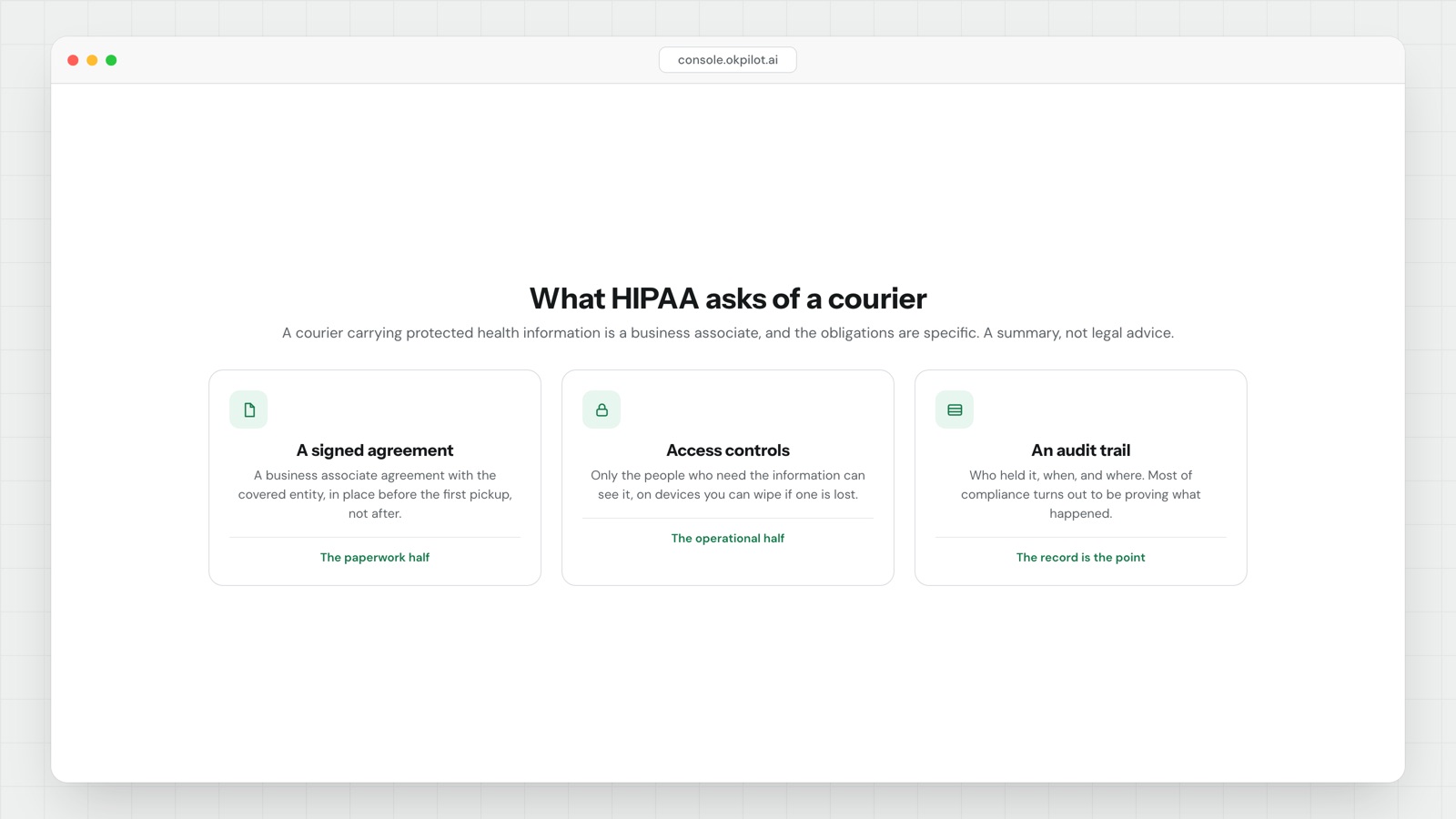
What HIPAA actually requires of a courier
Nobody certifies a courier as HIPAA compliant — what the rules actually require is a business associate agreement, access controls, an audit trail and a 60-day breach clock.
 Grocery and retail
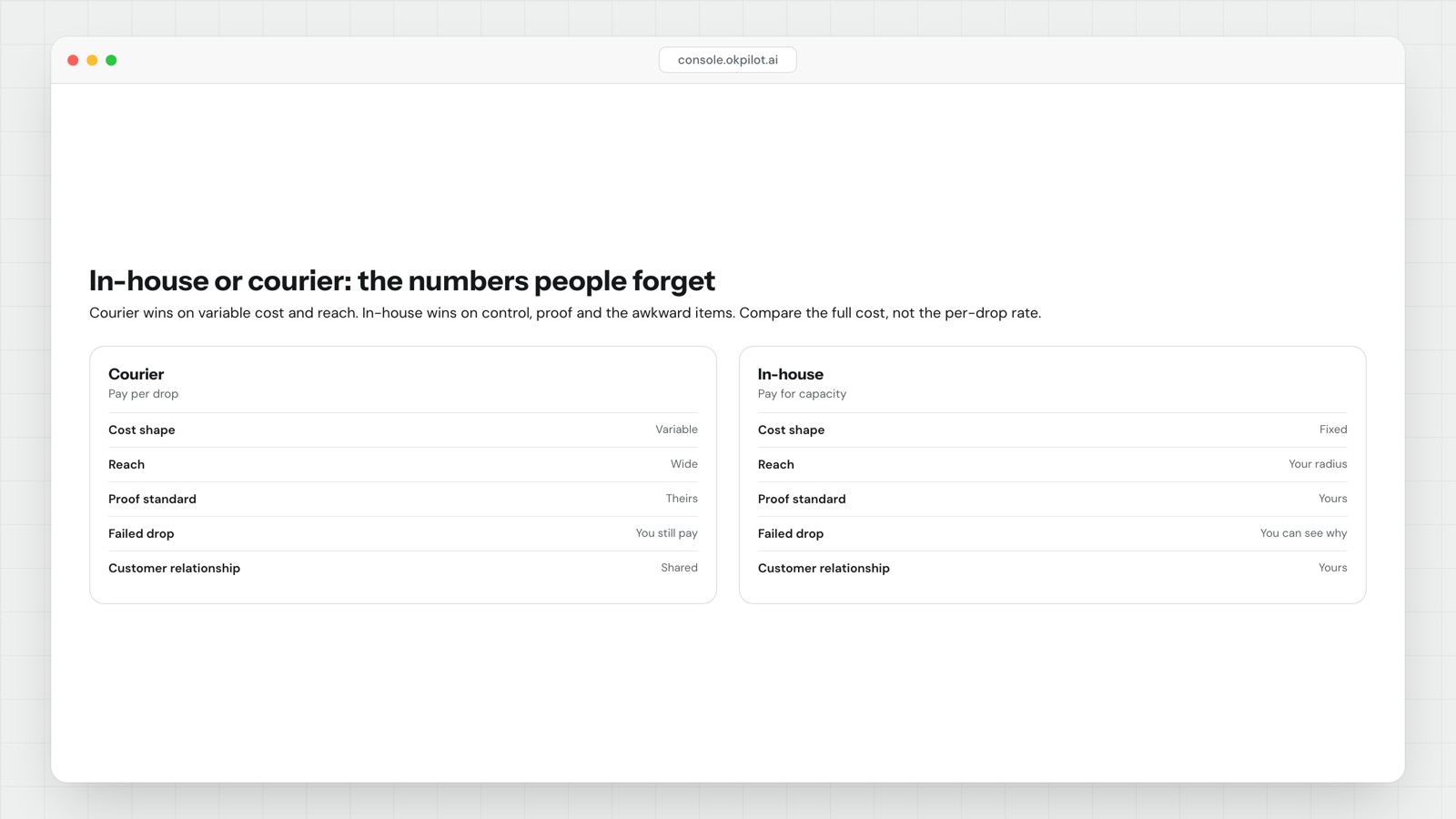
In-house delivery or a courier: deciding for a retail brand
A courier is cheaper per parcel until your daily drop count covers the fixed cost of a van. Here is the break-even, plus the costs most retail brands never put in the comparison.
 Dispatch and scheduling
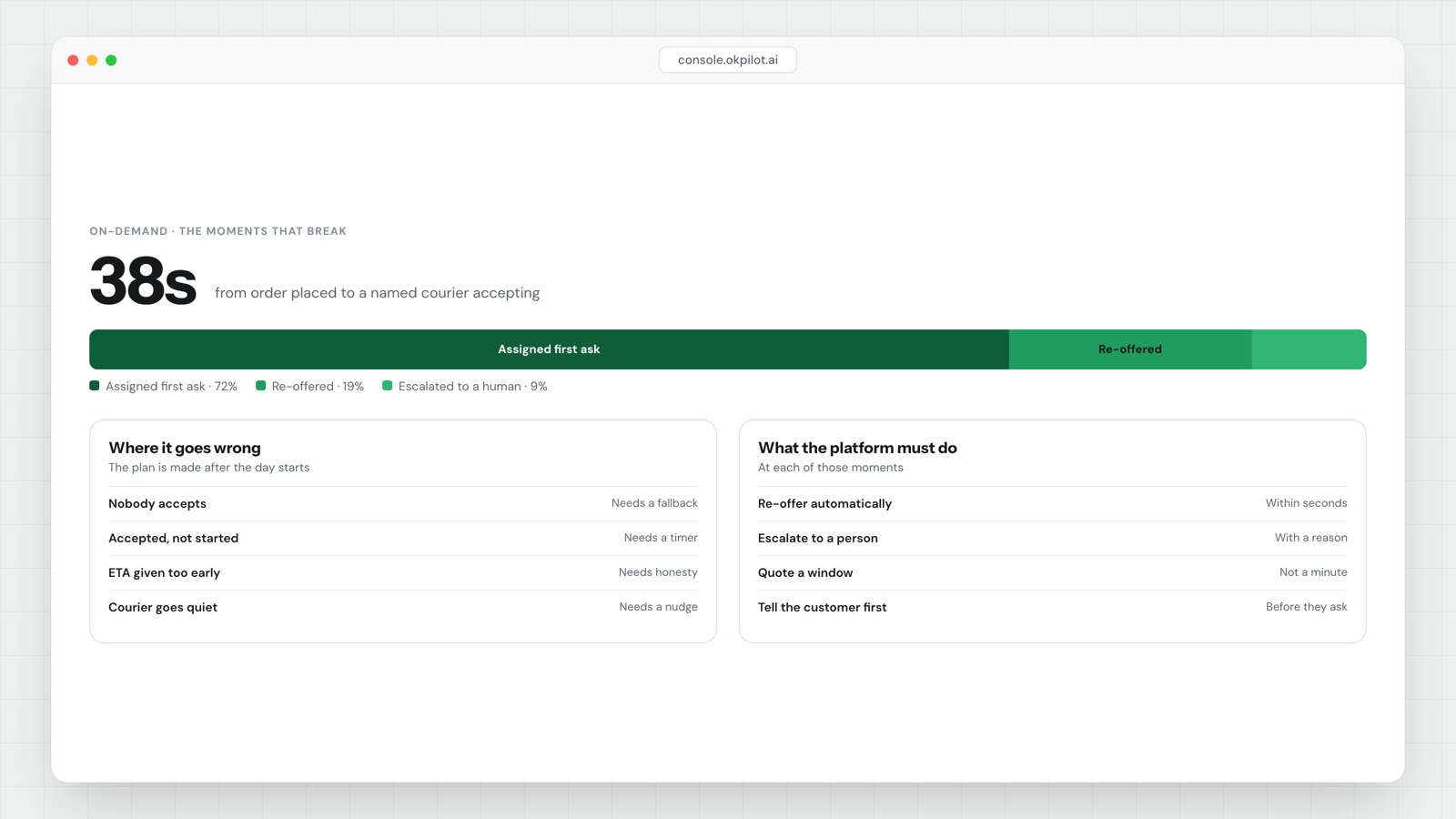
On-demand delivery: what the platform has to handle
On-demand delivery means the plan gets built after the day has started, which breaks at five specific moments — assignment, acceptance, the ETA, the no-accept gap and the mid-route change.
 Grocery and retail
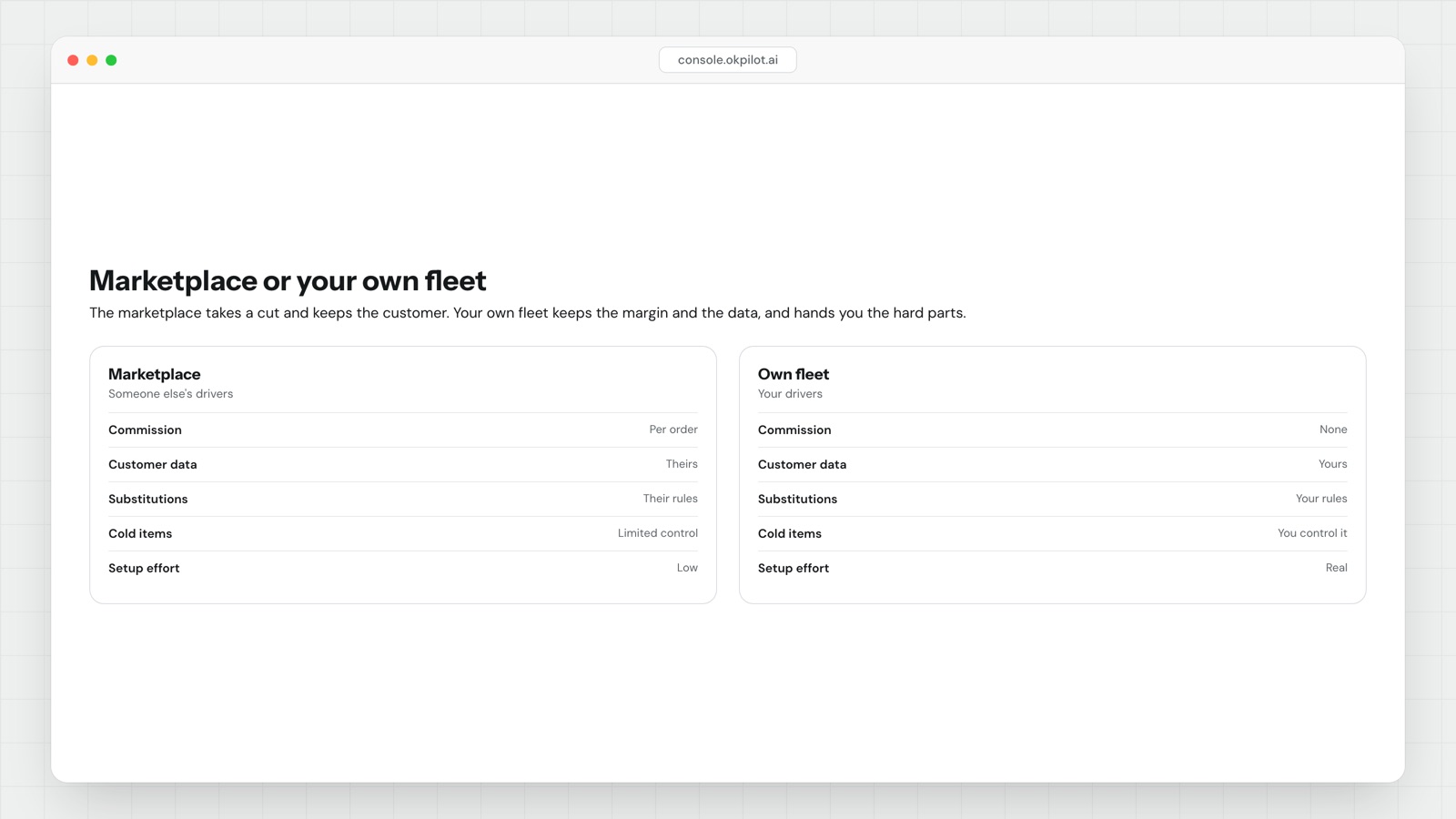
Running your own grocery delivery instead of renting someone else's
A marketplace charges a share of every basket; your own van charges you by the day. The two lines cross at one basket value, and that number decides whether running grocery delivery yourself is worth it.
 Pool and home service
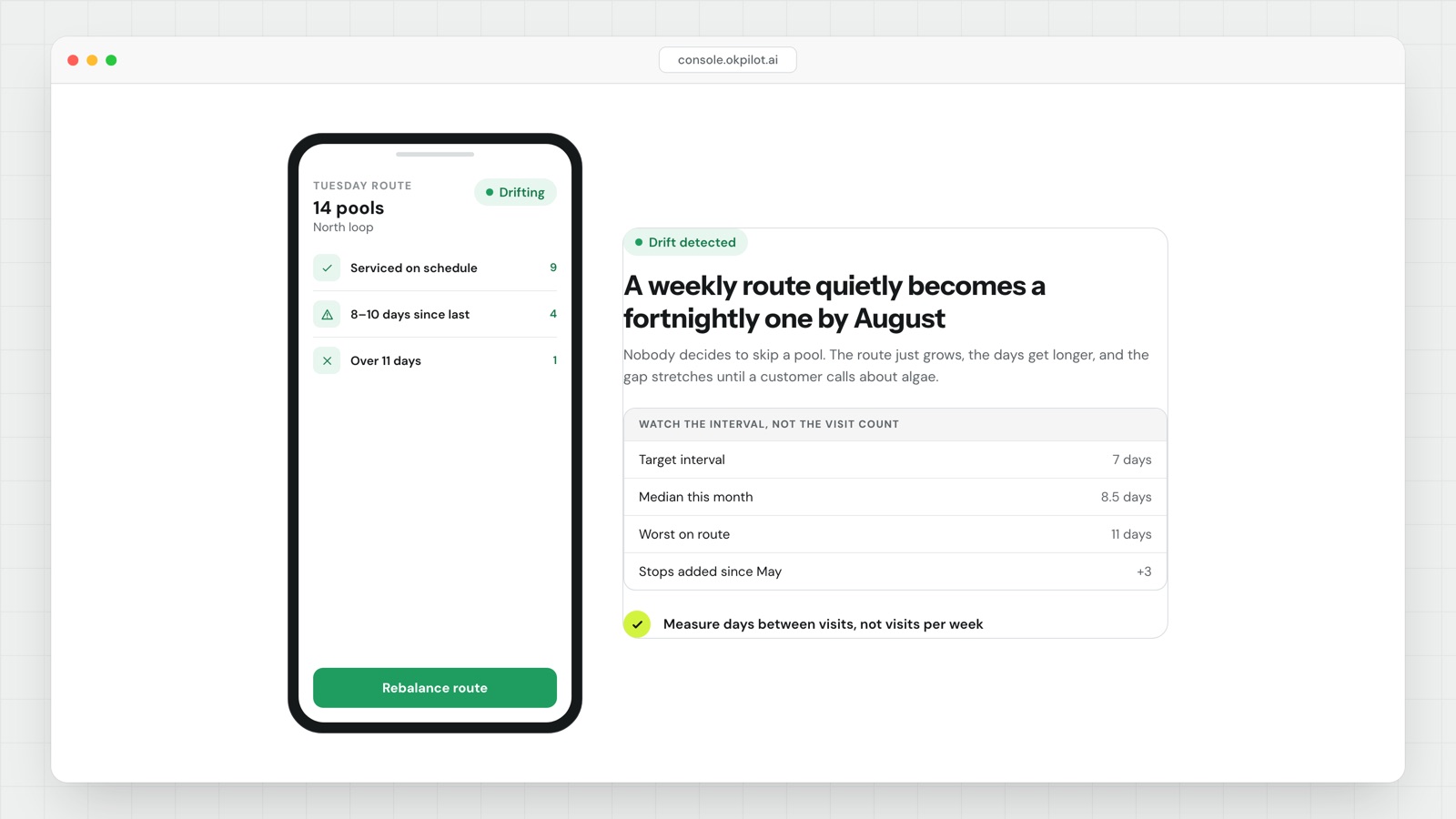
How often a pool route should actually be serviced
Weekly is the default interval for a residential pool route, but water temperature, bather load and screening set the real one, and here is how to catch a weekly route that has quietly drifted to ten days.
 Dispatch and scheduling
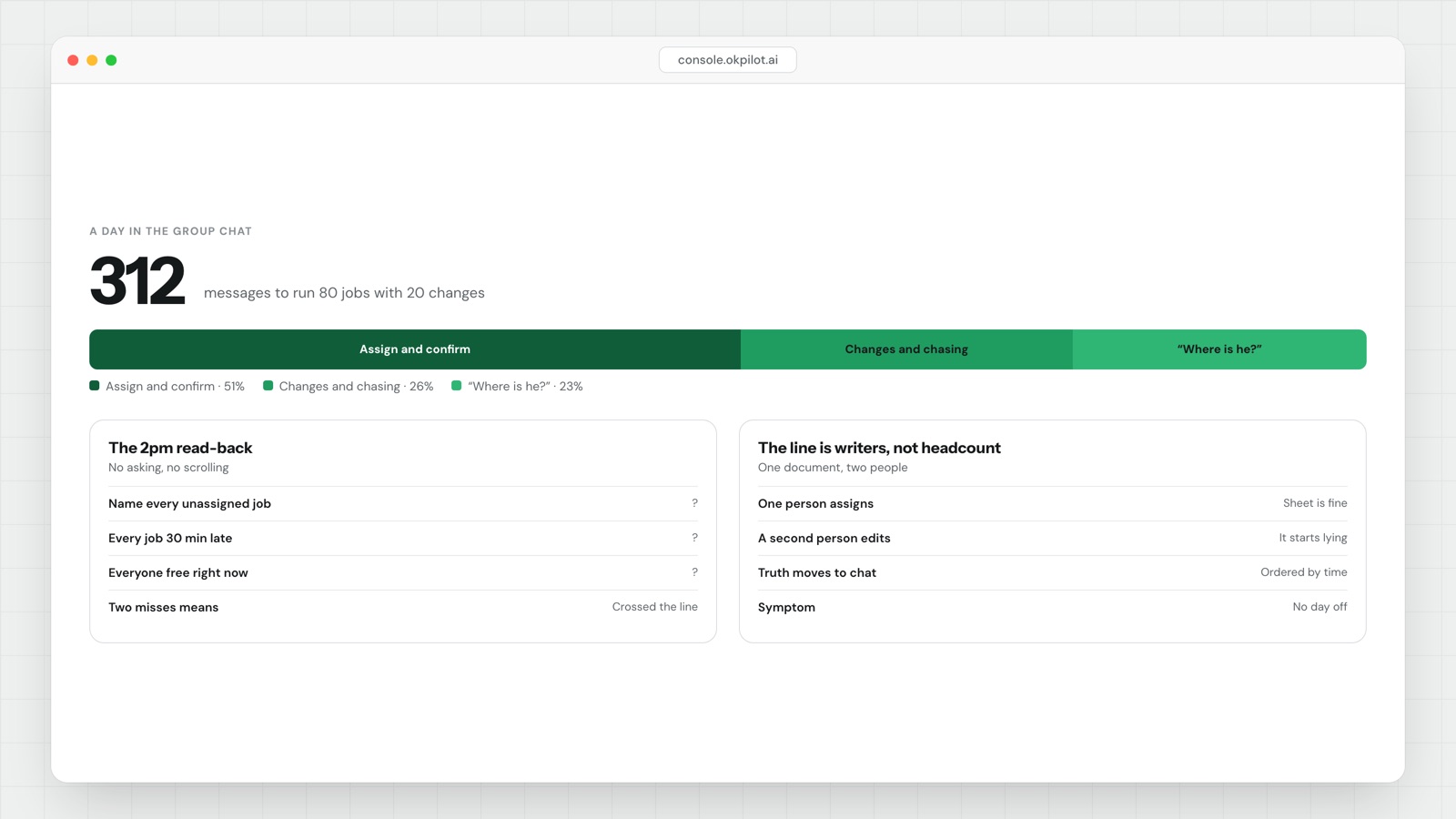
What dispatch software does that a spreadsheet cannot
A spreadsheet and a group chat genuinely run a field team until assignment state starts living in one person's head — here is how to tell whether yours has crossed that line.
 Routing and last mile
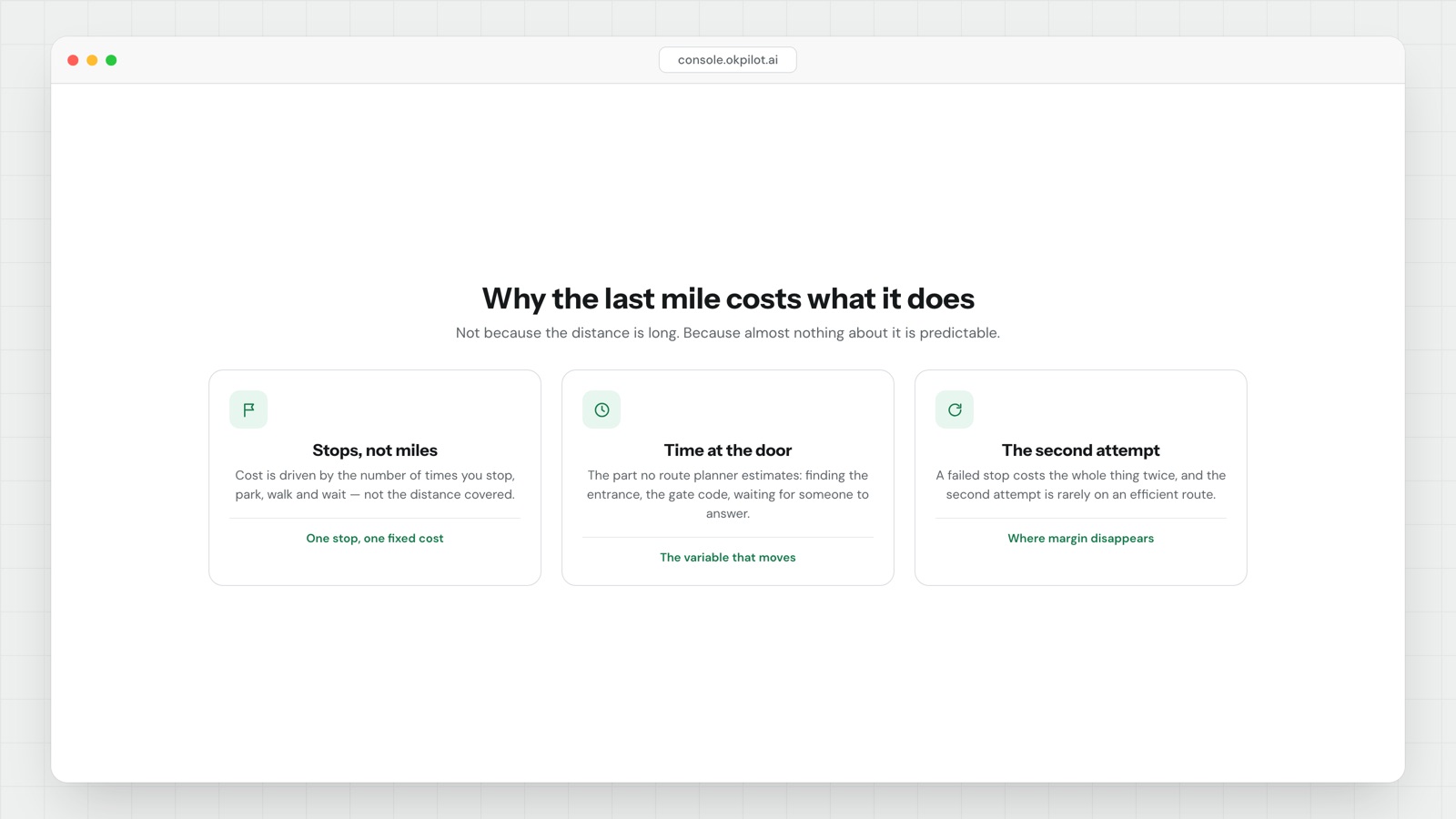
What last-mile delivery actually means when you run the vans
The textbook calls the last mile the final leg to the customer. For anyone running the vans it is the leg where cost per stop stops being predictable, and here is why that happens and how to measure it.
 Furniture
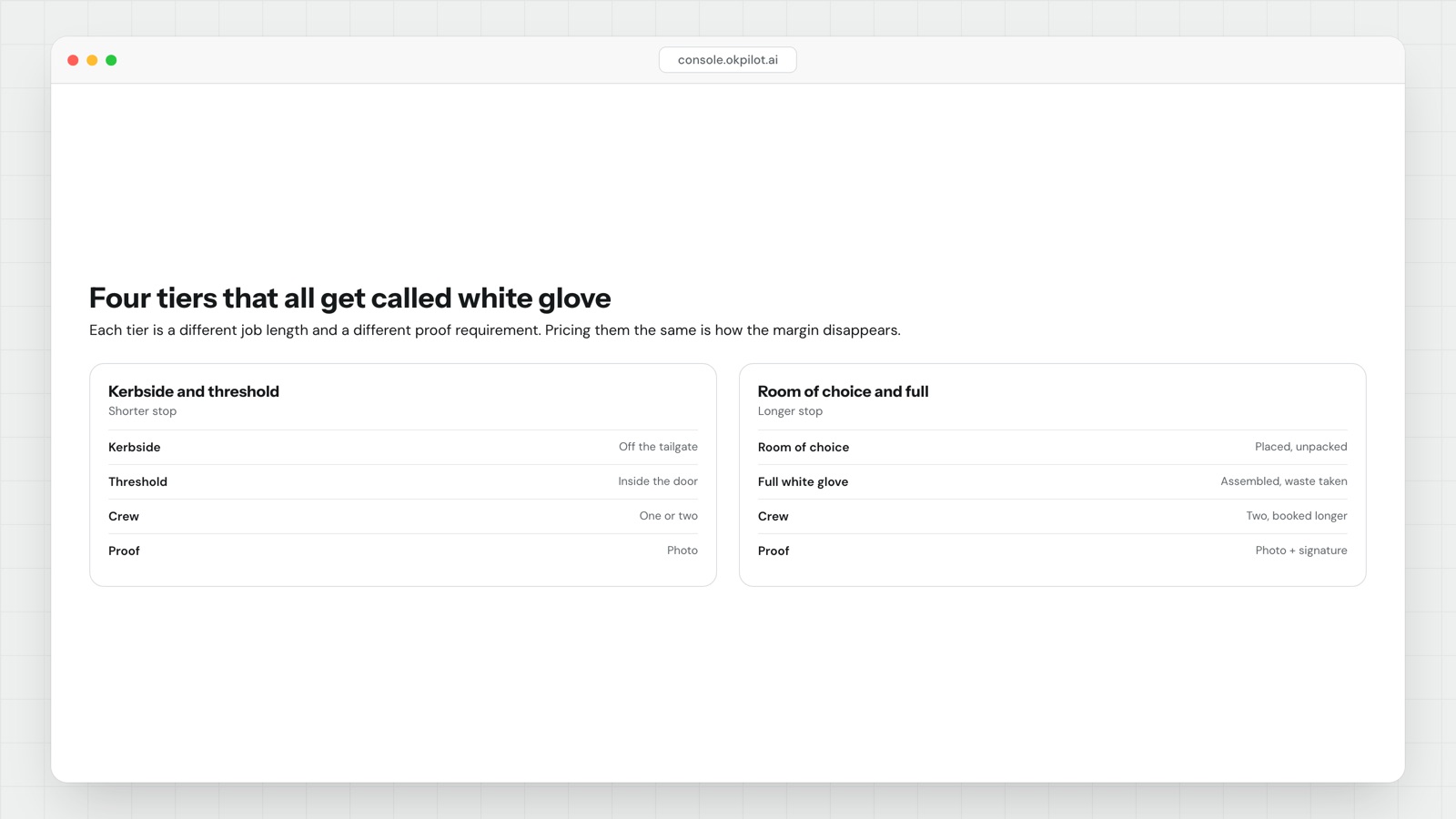
What white-glove delivery actually includes
White-glove delivery means four different jobs depending on who is selling it — kerbside, threshold, room of choice, or full service with assembly and packaging removal. Each is a different job length and a different proof requirement, and pricing them alike is how the margin goes.
 Furniture
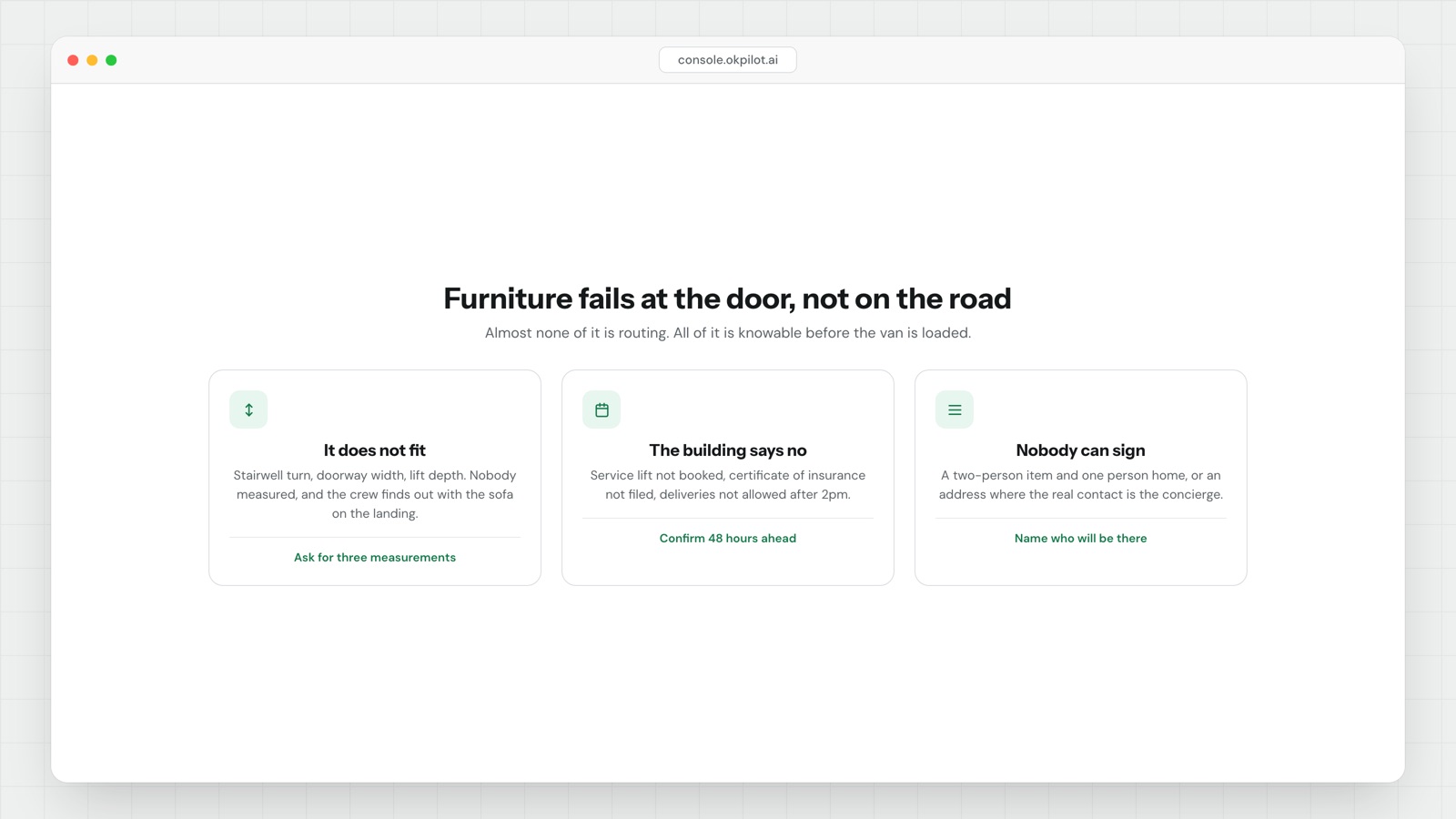
Why furniture delivery fails at the door, not on the road
Most failed furniture deliveries are access failures, not routing failures — the sofa will not turn on the landing, the goods lift is booked, the building wanted an insurance certificate two days ago. Here is the survey that catches them first.
 Proof and compliance
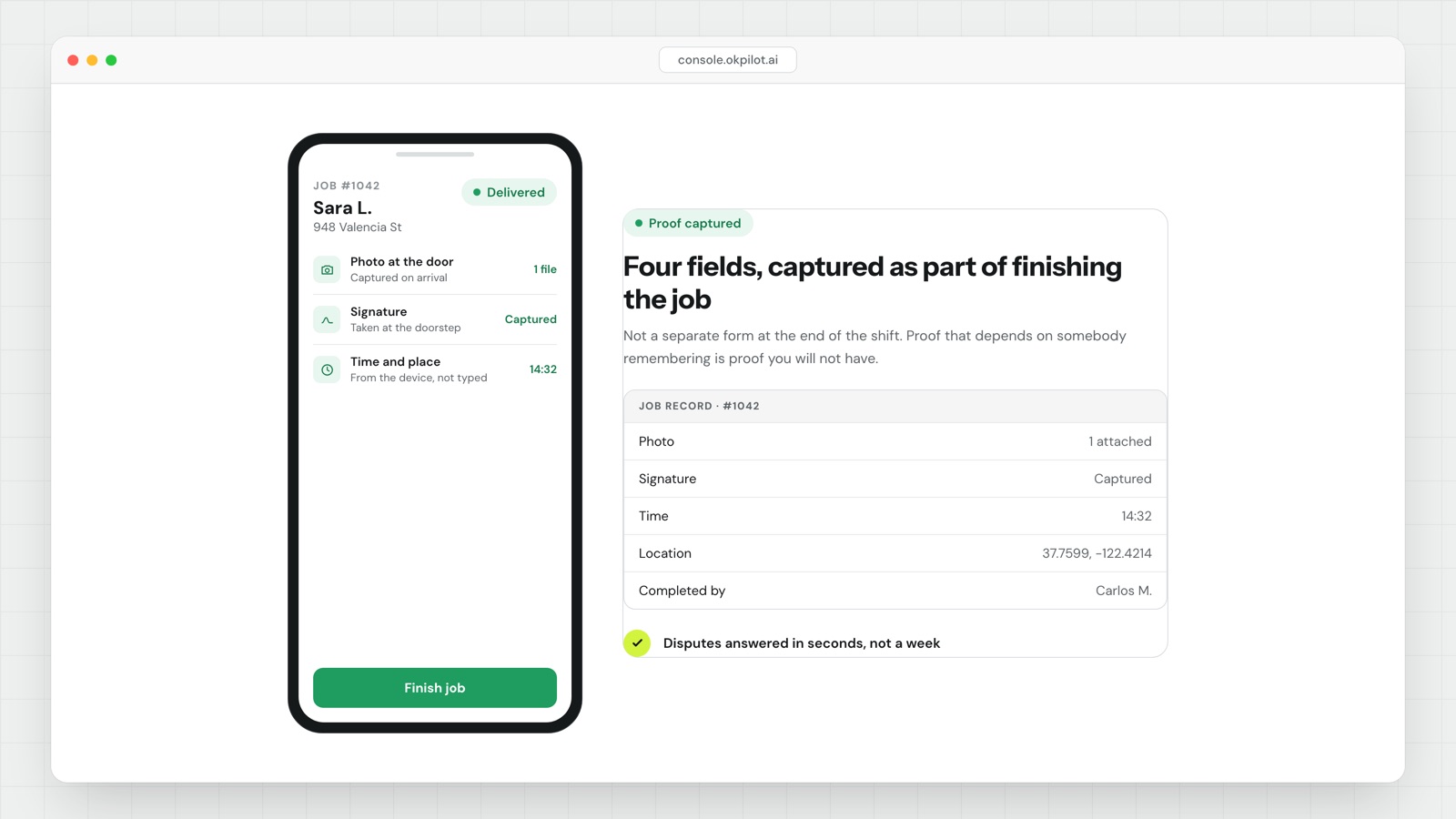
Electronic proof of delivery: what it actually proves
Electronic proof of delivery captures a photo, signature or code at the point of handover with the time and place attached — here is what that settles, and what it does not.
 Proof and compliance
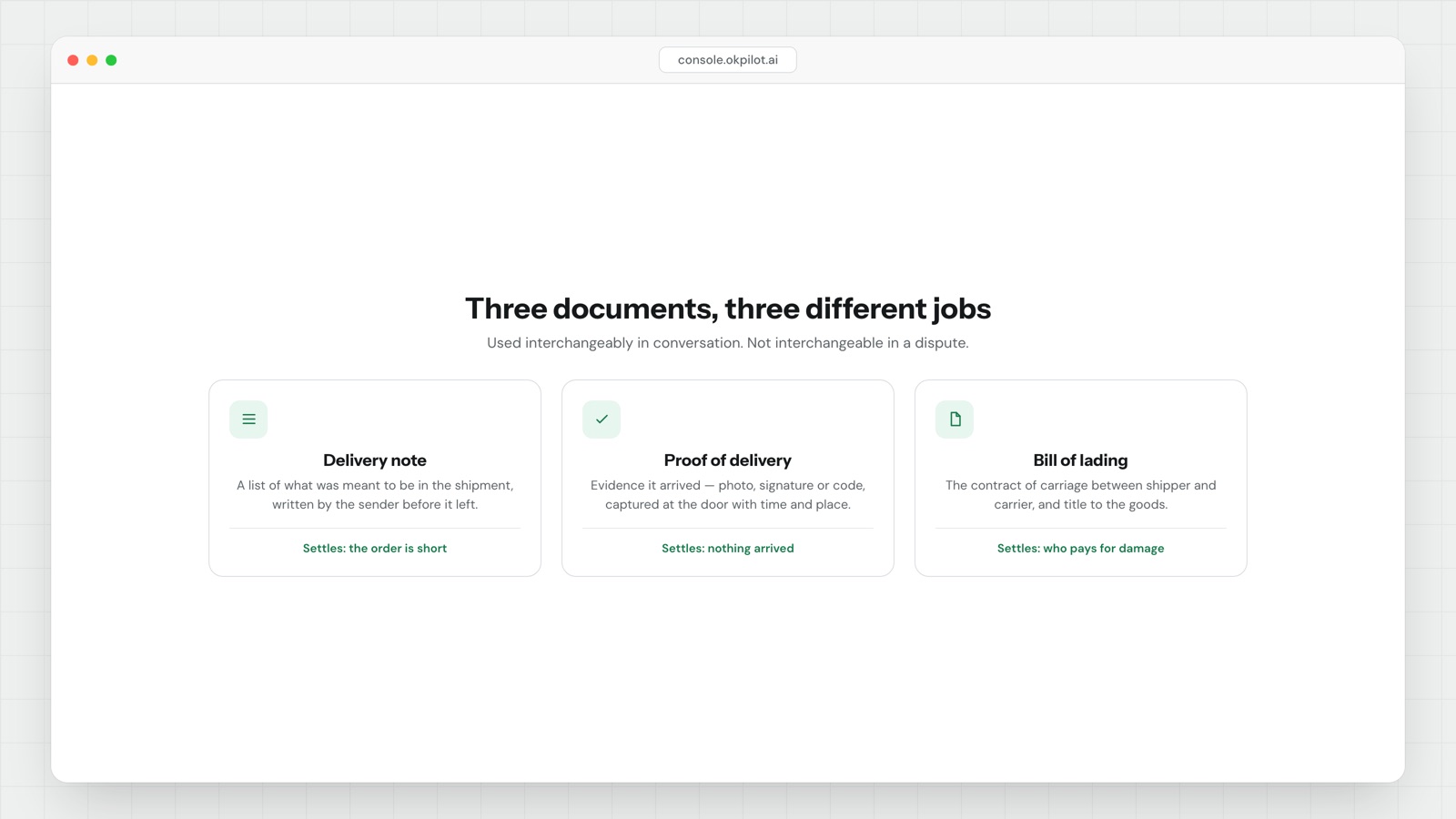
Delivery note, proof of delivery, bill of lading: which is which
Three documents that get used interchangeably in conversation and are not interchangeable in a dispute — here is what each one actually proves.
 Metrics
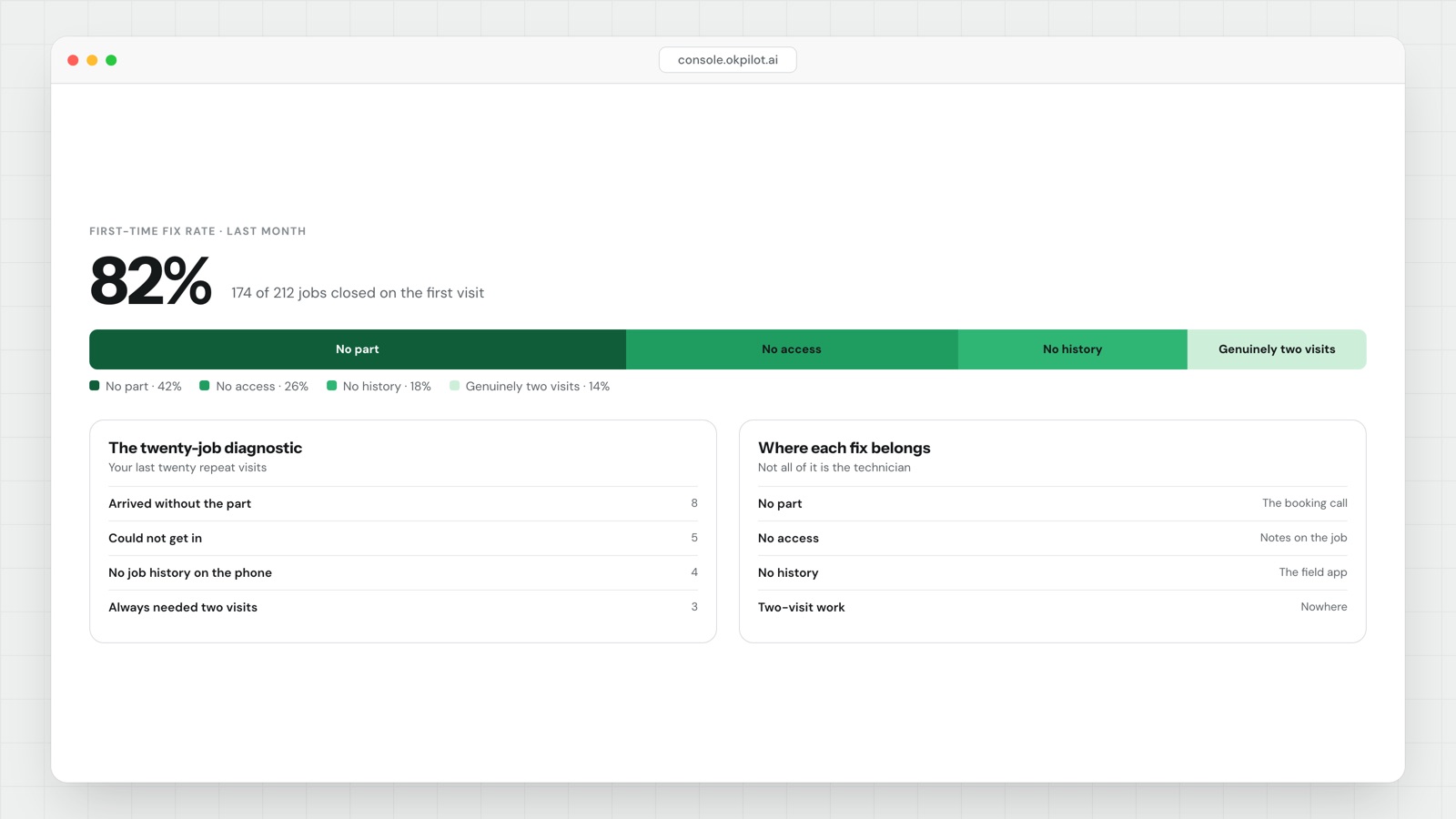
First-time fix rate: the formula, and why the benchmark is a trap
First-time fix rate is the share of jobs closed on the first visit — a simple formula that most teams calculate three different ways without noticing.
 Proof and compliance
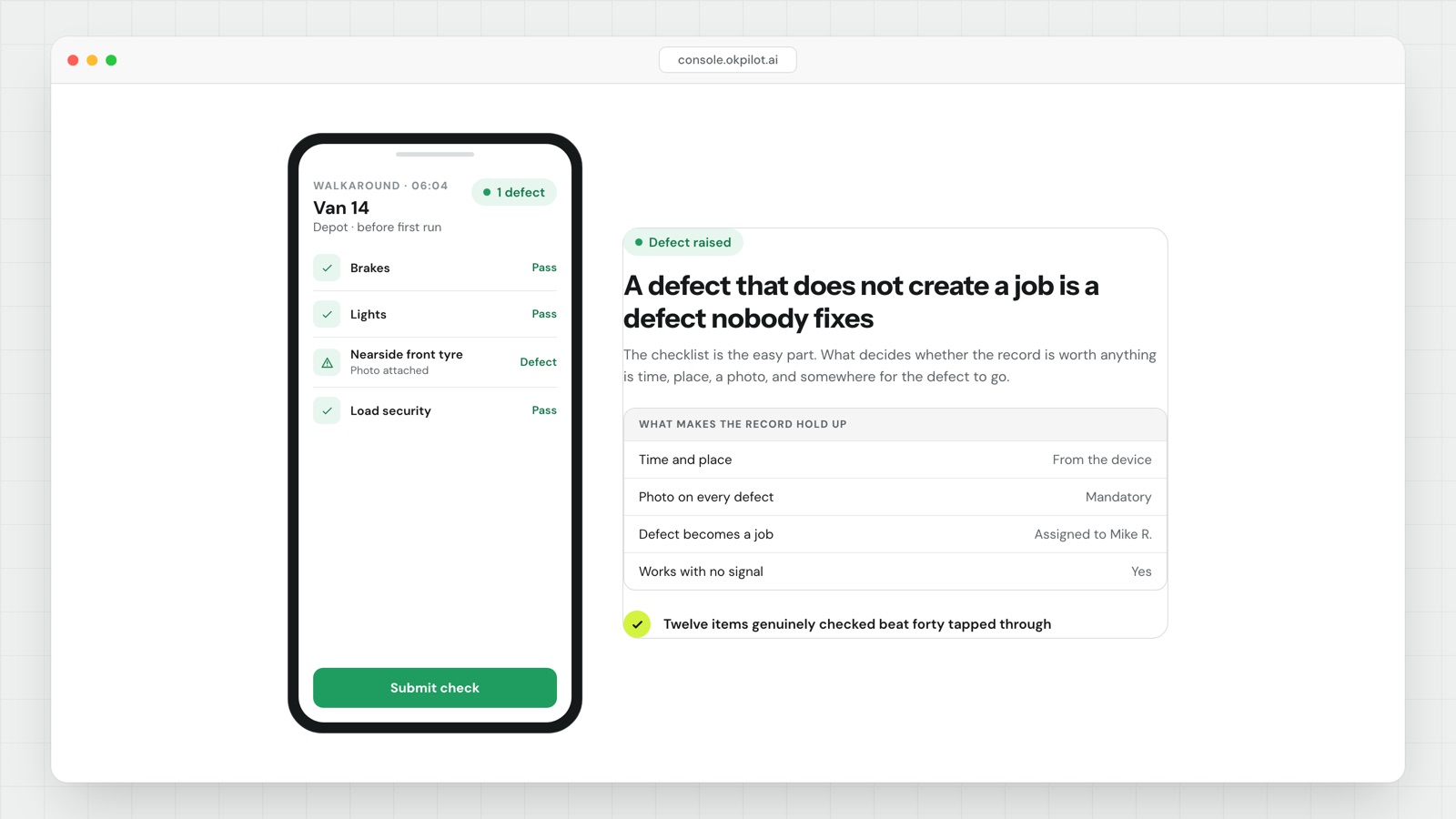
Pre-trip inspection apps: what they replace and what they must capture
A pre-trip inspection app replaces the paper walkaround sheet with a timestamped digital record — and the point is not the checklist, it is being able to prove the check happened.
 Dispatch and scheduling
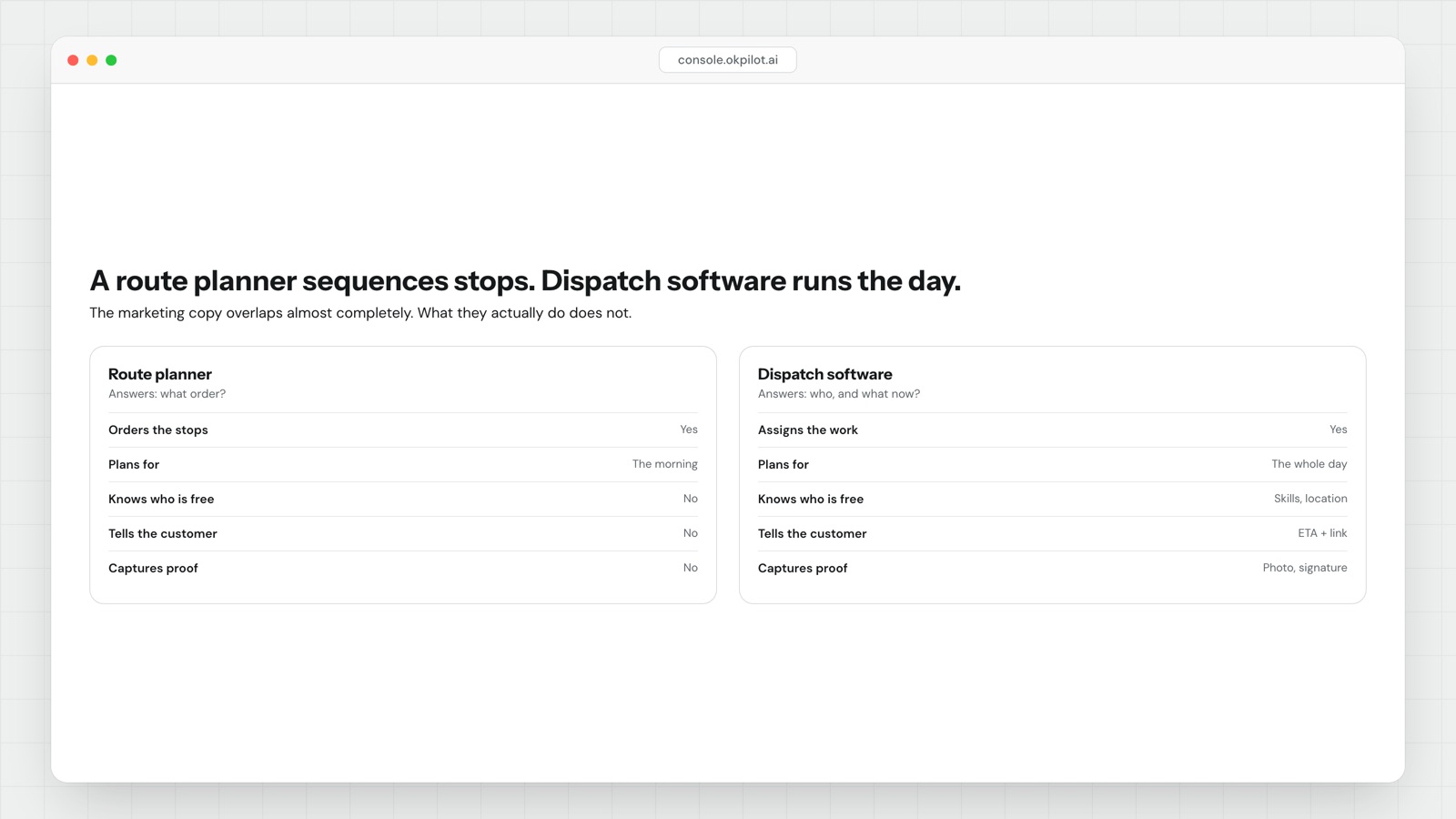
Route planner or dispatch software: which one you actually need
A route planner sequences stops. Dispatch software decides who goes and what happens when the day changes — most teams buy the first and need the second.
 Choosing software
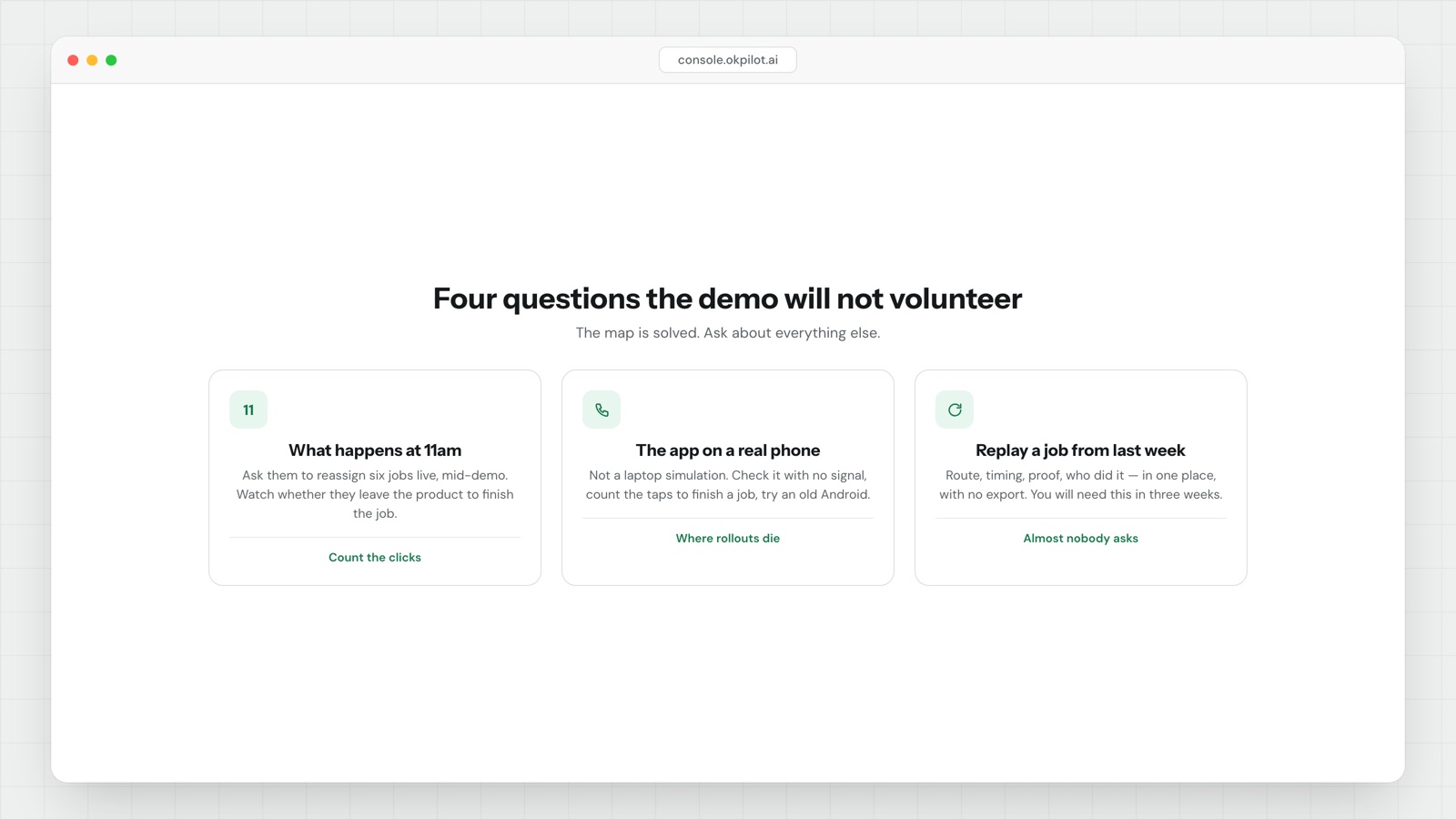
How to choose delivery management software without buying the wrong thing
Most delivery software demos show you the same map with the same moving dots — here is what to ask instead, and the four questions that actually separate these tools.
 Routing and last mile
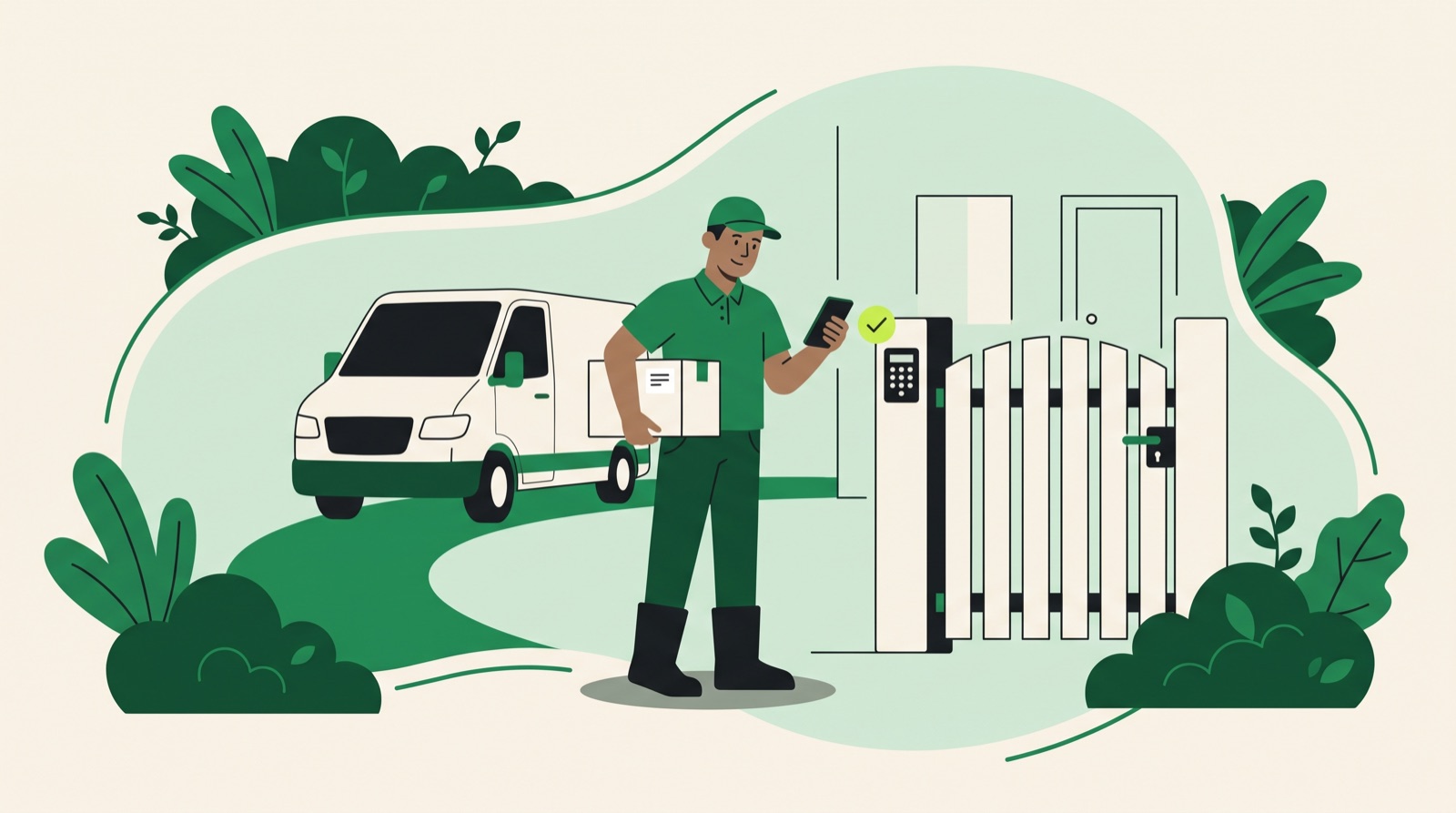
Routing is solved. Getting inside is not.
Route optimization gets your driver to the address fast — it's what happens at the gate, the dock, or the front door that actually decides how long the stop takes.