In-house delivery or a courier: deciding for a retail brand
In short
Use a courier until your daily drop count clears the fixed cost of a van, then move the high-value and awkward orders in-house. Retail delivery software is what makes that in-house half cheaper, rather than just more controlled.
Break-even drops per day = fixed daily cost of van + driver
                           ÷ courier price per drop

e.g. £180 per day ÷ £5.50 per parcel = ~33 drops per day- Courier cost is variable and close to linear. In-house is a fixed daily cost divided by however many drops you actually complete. Below break-even the courier wins on price, every time.
- The number that usually flips the decision is not the per-parcel rate. It is the full cost of a failed first attempt, and most brands have never calculated theirs.
- In-house wins where something has to happen at the door: assembly, an ID check, a signature that matters, a return taken away, a narrow window you promised.
- The courier wins on geography and on peaks. One van cannot cover a county, and you cannot hire a December driver in December.
- Check your courier's liability cap before assuming high-value goods are covered. It is in the contract, and it is usually well below retail price.
- Most brands end up splitting by order type, not by region.
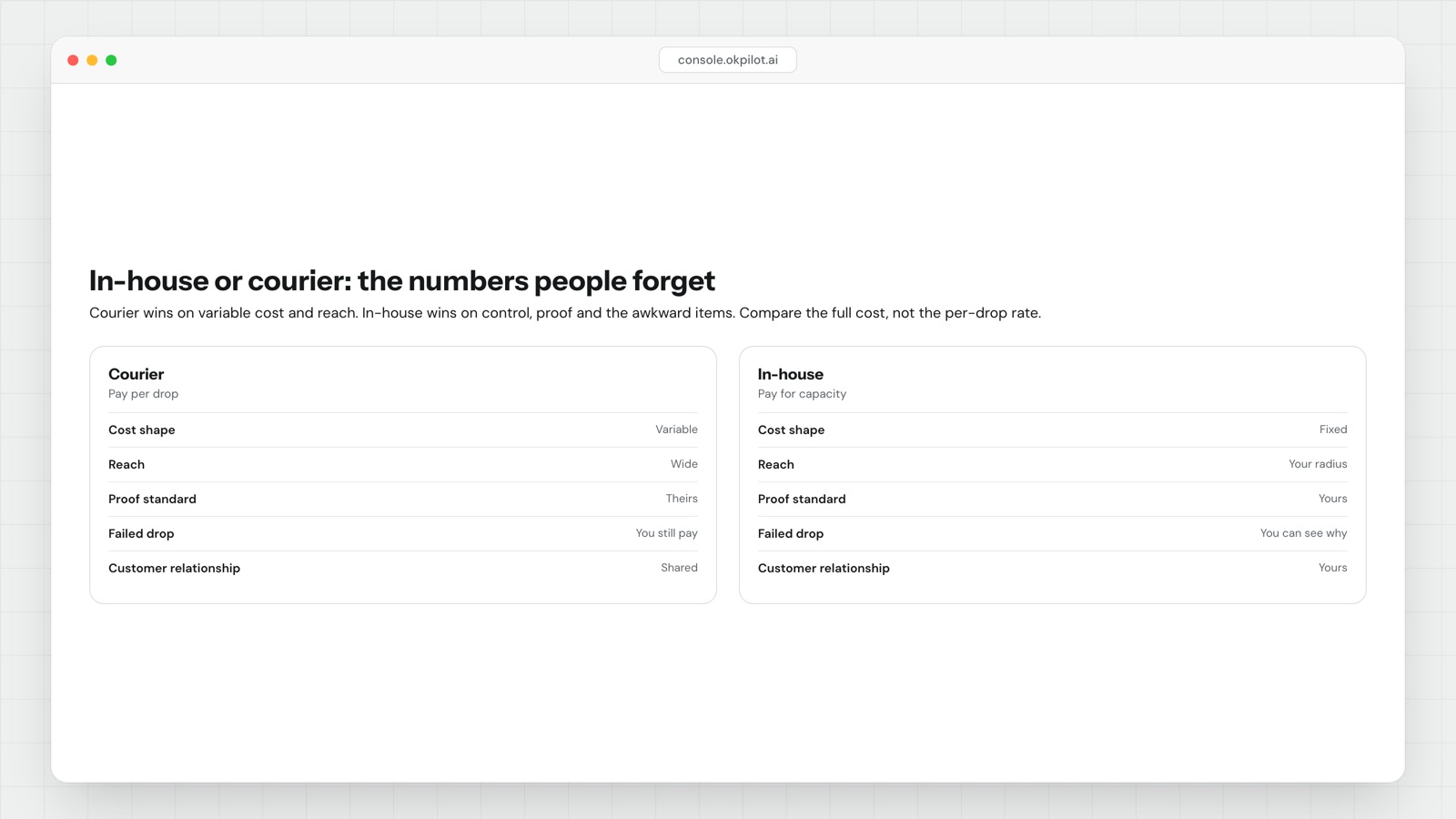
| Courier | In-house | |
|---|---|---|
| Cost shape | Variable per parcel | Fixed per day ÷ drops |
| Wins when | Volume is low or spread out | Volume is dense |
| Reach | National, next day | One cluster per van per day |
| Peak capacity | Theirs to absorb | Yours to hire for |
| Proof at the door | Scan, sometimes a photo | Whatever you specify |
| Failed attempt | Their process, your refund | Yours to retry same day |
| Data you keep | Scan events | Everything |
The two cost curves, and where they cross
A courier charges you per parcel. A van charges you for the day whether it goes out full or half empty. That is the whole shape of the decision.
Get your fixed daily cost right before you compare anything. It is not the lease payment. It is driver wages and employer costs, vehicle finance or rental, insurance, maintenance set aside per day, fuel, parking and fines, plus the share of a dispatcher's day that the van consumes. Divide the annual total by the days the van actually runs, not by 365.
In-house cost per drop = fixed daily cost ÷ drops completed per day
Break-even drops per day = fixed daily cost ÷ courier price per drop
At £180 a day against a £5.50 parcel rate, break-even is about thirty-three drops. Thirty-three is the honest number to argue about, because it is a question about density, not control: can one van, inside one cluster, actually complete thirty-three drops in a day at your service times? If your average door takes eight minutes and your drive legs average six, that is fourteen minutes a drop, so thirty-three drops is about seven and a half hours of pure work with no breaks and no traffic. Probably not. So either the cluster has to be tighter or the comparison has to include the costs below.
The numbers people forget
Three of them, and they all favour in-house.
The full cost of a failed first attempt. Not the redelivery fee. All of it:
True cost of a failed first attempt =
    outbound leg
  + return leg
  + re-pick and restock labour
  + redelivery leg
  + (support contacts × cost per contact)
  + P(cancellation) × gross margin on the order
  + P(damage in handling) × item cost
Most brands have the inputs and have never multiplied them. If your first-attempt failure rate is six per cent and a failure costs four times a successful delivery, your average delivery costs eighteen per cent more than a successful one — and that eighteen per cent sits inside the courier's cheap per-parcel rate without appearing on the invoice.
The cost of not knowing. Every order with no live status carries some probability of a "where is my order" contact. You can price it from data you already hold:
Cost per contact = handling minutes × loaded hourly cost ÷ 60
e.g. 6 min × £22/hr ÷ 60 = £2.20

Contacts per order = delivery enquiries last month ÷ orders shipped last month
Count the delivery enquiries in last month's inbox and divide by orders shipped. Multiply by cost per contact. That number is the price of not having a tracking link, and it is yours, not a benchmark someone invented.
The cost of unprovable deliveries. Without evidence at the door, "it never arrived" is a refund by default. Assume you lose every claim you cannot evidence: the expected cost per drop is your claim rate times your average order value. Then look at your courier's liability cap. On a £600 item, a capped claim settled in eight weeks is not insurance, it is a partial rebate. What survives a dispute is covered in electronic proof of delivery.
Add those three to the courier side and the break-even drop count falls, often sharply. It is still a real number: for a brand doing twelve drops a day across scattered postcodes it will still favour the courier.
Where in-house genuinely wins
Not everywhere. Specifically:
- Value above the courier's liability cap. Furniture, appliances, jewellery, electronics. The risk is not theoretical and the cap is in your contract.
- Anything that needs a person to do something. Two-person carry, final assembly, a bike that needs the bars turned, a mattress taken upstairs and the old one taken away, an age check, a measurement at the door.
- Returns and exchanges taken on the spot. A driver who leaves with the wrong item is the cheapest returns process there is, and no courier offers it.
- Narrow windows and same-day promises. If you are selling a two-hour slot, you need to control the van. You cannot subcontract a promise you cannot see.
- Where the delivery is part of the product. If people buy from you because the delivery experience is better, handing it to a third party removes the thing they are buying.
Where the courier genuinely wins
- The long tail of geography. One van is one cluster. Everything outside it is a courier job and arguing otherwise is expensive.
- Low-value small parcels. Below a certain order value the courier's marginal cost is nearly nothing and yours is a whole day.
- Peaks you cannot staff. Their capacity flexes; yours is a hiring decision made three months early.
- Evenings, weekends and anything international.
Plenty of brands have brought delivery in-house, discovered that twenty-two drops a day does not pay for a van, and quietly gone back.
Picking the split, and what retail delivery software has to do
Decide per order, with a rule the warehouse can apply without a meeting:
Send it in-house if the address is in a cluster you already serve that day
AND any one of:
    order value > courier liability cap
    something must happen at the door
    you promised a same-day or sub-2-hour window
Otherwise: courier.
The first condition is the one that matters, because the in-house half only beats the courier when drops per van per day stay above break-even. That makes density the whole job: clustering orders so one van has a tight, full day; reassigning when a drop fails rather than paying for the day twice; capturing proof so disputes stop becoming refunds; and giving the customer a live link so the enquiry never arrives. Planning the route is the easy half of that — see route planner or dispatch software.
Review the split quarterly against two measured numbers: actual drops per van per day, and actual cost per drop including failures. If drops per day sit below your break-even for a full quarter, the in-house decision is wrong and no amount of control will fix it.
OkPilot runs the in-house half — dispatch, live tracking for the customer, proof on every drop — described in plain instructions rather than configured screen by screen. The detail is on the delivery management software page.
See OkPilot running your own operation
A live walkthrough with a real person, configured to your jobs on the call. About ten minutes. Setup takes around 48 hours.