First mile, middle mile, last mile: who owns which part
In short
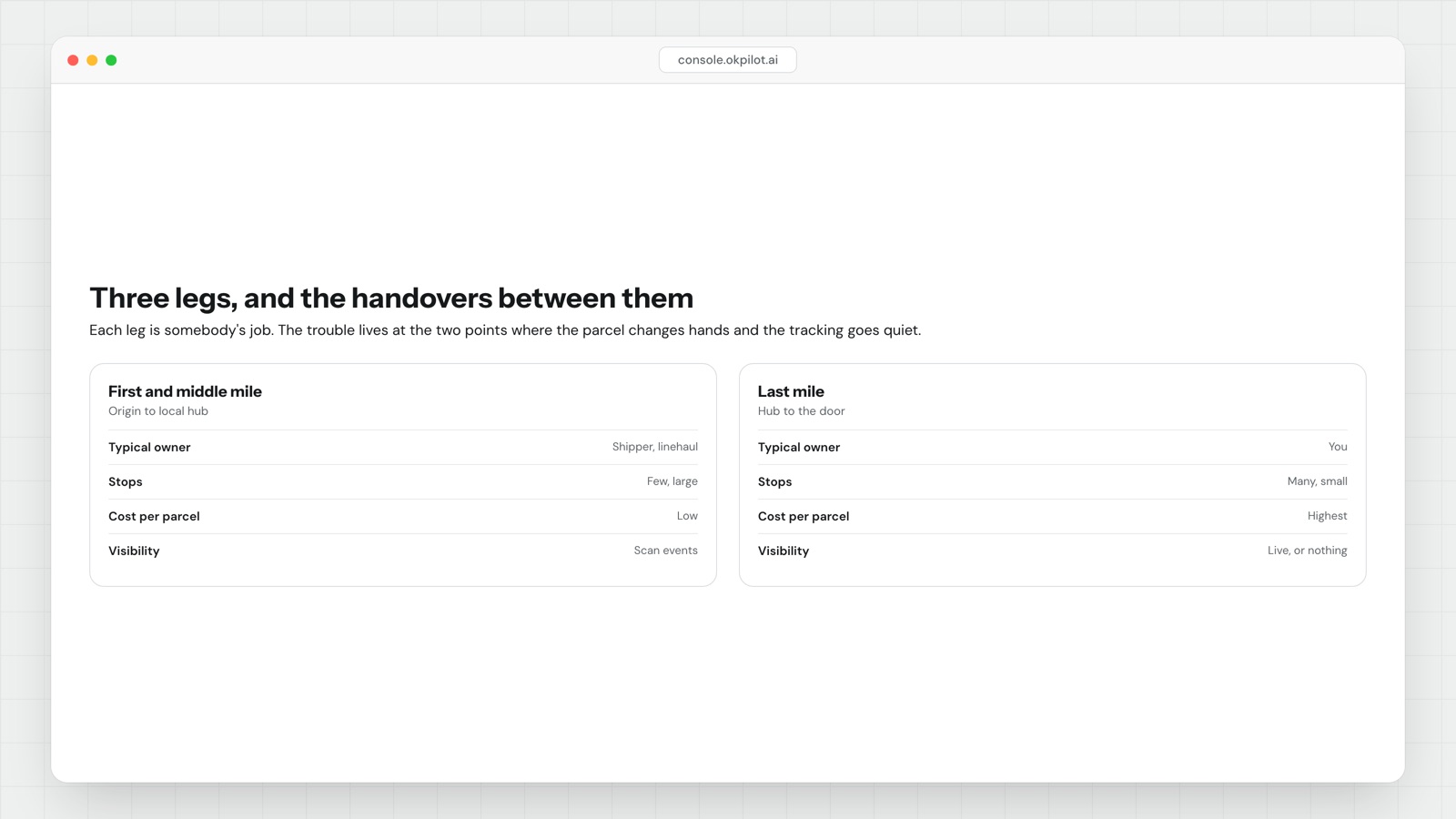
Last mile, first mile and middle mile are three different cost structures that happen to share the same parcel. First mile is collection, from the supplier or shipper into the network. Middle mile is the bulk haul between facilities. Last mile is the final delivery to the customer.
| Leg | Unit of work | Who usually owns it | Tracking resolution |
|---|---|---|---|
| First mile | A pickup | Shipper, courier, or a 3PL collection fleet | Good at the dock, patchy until the first depot scan |
| Middle mile | A pallet, cage or trailer | Linehaul carrier, forwarder, or your own trunk fleet | Vehicle-level, not parcel-level |
| Last mile | A stop | Last mile carrier, your own vans, or a gig pool | Highest: scan, photo, signature, live ETA |
- The definitions are easy. The handovers between them are where things actually go wrong.
- There are four handovers: shipper to first mile, first mile to middle mile, middle mile to last mile, and last mile to customer.
- Liability, the unit of work, and the tracking identifier can all change at the same handover, usually without a single record tying the before and after together.
- Tracking goes dark during the middle mile because the parcel has been consolidated and only the vehicle is being scanned.
- A fifth handover exists and nobody owns it: the failed delivery coming back into the network.
Last mile, first mile, middle mile: what each leg actually does
First mile is getting goods from wherever they are made or stored into the transport network. A van collecting fourteen cartons from a factory dock. A pharmacy wholesaler loading the morning's cages. You pay per pickup or per vehicle hour, and it is scheduled rather than optimised, because collection points are few and known.
Middle mile is the long, boring, cheap-per-unit part. Depot to depot, port to depot, hub to hub. The unit of work is a pallet or a trailer, not an order. It benefits most from scale and least from software, and it is where your cost per parcel is lowest.
Last mile is the final delivery. One order, one door, one chance to get it right. The unit of work is the stop, and the cost per unit is an order of magnitude above anything upstream — mostly because of what happens after the van arrives, which we went through in routing is solved, getting inside is not.
Most operations run two of the three themselves and buy the third. The problem is that the seams between them are nobody's job.
The four handovers, and exactly what breaks at each
Shipper to first mile, at the dock
What changes: custody and liability.
What breaks: piece count, and the timing of the record. The driver takes fourteen cartons, the manifest says fifteen, and nobody reconciles it until the depot that evening. Worse, in a lot of operations the pickup scan happens at the depot rather than at the dock, so there is a window of several hours where goods sit in a van with no event saying they ever left the shipper. If something is missing, there is no evidence either way and the dispute goes to whoever argues harder.
The fix is cheap: scan at the dock, with a photo of what was loaded and a signature from whoever handed it over. Done at the dock, a count dispute is a thirty-second conversation. Done at the depot, it is a claim.
First mile to middle mile, at the origin sort
What changes: the unit of work. The parcel stops being a parcel and becomes part of a pallet, a cage or a container.
What breaks: mis-sorts, and tracking resolution. Parcel-level events stop here, because there is nothing to scan a parcel against until it is broken down again. Your tracker shows "in transit" for a day or two, and your service team answers questions it has no data for.
The quieter failure is re-labelling. If the next carrier uses a different identifier scheme, the link between the two numbers is a row in a database. If that row is wrong, the parcel is not lost, it is invisible, which is harder to fix because nobody is looking for it.
Middle mile to last mile, at the injection point
What changes: often the company. Always the SLA clock.
What breaks: blame. The trunk was due at 02:00 and arrived at 04:40. The sort finishes late. The last mile carrier inherits the same promised delivery day with two fewer hours to do it in. The breach gets recorded against the last mile, and the cause was a hundred miles upstream.
If you take one thing from this post, take this: record planned against actual arrival at the injection point as its own metric, separate from delivery performance. Teams that do not split these two spend a year trying to fix a last mile problem that is a linehaul problem.
The second thing that breaks here is the customer's tracking link. A new carrier means a new tracking number. Either the old link stops updating or the customer receives a second one, and both outcomes generate a contact.
Last mile to customer, at the door
What changes: custody leaves the network entirely.
What breaks: proof. "Left with neighbour." "Delivered to reception." A signature from someone whose name nobody wrote down. This is where disputes land weeks later, and the evidence either exists or it doesn't. A timestamped photo at the point of handover ends almost all of them, which is the whole argument for electronic proof of delivery.
The fifth handover: the failed attempt going back
What changes: officially, nothing. The parcel goes into a van, then a cage, then onto a shelf.
What breaks: ownership. The last mile carrier recorded an attempt, so by their measurement they performed. The shipper sees an exception and waits. Nobody has a deadline. This is where parcels sit for a week.
Give the re-attempt queue an owner and a clock. Not a process document — a named person and a number of hours.
Where tracking goes dark, and for how long
Visibility is a function of how often the thing you care about gets scanned. Parcel-level scans happen at handovers and at the door. Between handovers, the only scans are vehicle-level. So the dark period is not a software gap you can buy your way out of. It is a consequence of consolidation: you made the unit bigger to make the haul cheap, and the parcel lost its own identity for the duration.
Measure yours. Take twenty shipments that went end to end, list every tracking event with its timestamp, and find the largest gap between consecutive events. That gap, in hours, is what your service team is answering questions about with no information. In most multi-carrier networks the biggest one sits between the origin sort and the destination sort.
You cannot remove the gap. You can tell the customer about it before they ask, which costs nothing and prevents the contact.
The handover audit
For each of the five handovers, answer four questions in writing:
- Who holds liability after it? Name the party, and the clause.
- What event records it? A scan, a signature, a photo, an EDI message, or nothing.
- How long after the physical event does the record appear? Minutes, hours, or at end of shift.
- Who gets measured when it goes wrong? And is that the same party that caused it?
Any handover where question two answers "nothing" or question three answers "at end of shift" is a handover that will produce a dispute you cannot win. Any handover where the answer to question four is "not the party that caused it" is a handover that will never improve, because the people with the problem are not the people with the lever.
That audit is a whiteboard exercise, not a purchase. The only question software changes is the third one. On the legs you run yourself, whether that is delivery or a courier network, OkPilot captures the event at the moment it physically happens — scan, photo, signature, timestamp — which turns those handovers from arguments into records. It does nothing about handovers inside somebody else's network, and a vendor who claims otherwise is selling you a tracking page, not visibility.
See OkPilot running your own operation
A live walkthrough with a real person, configured to your jobs on the call. About ten minutes. Setup takes around 48 hours.