What a DVIR must contain, and how long you have to keep it
In short
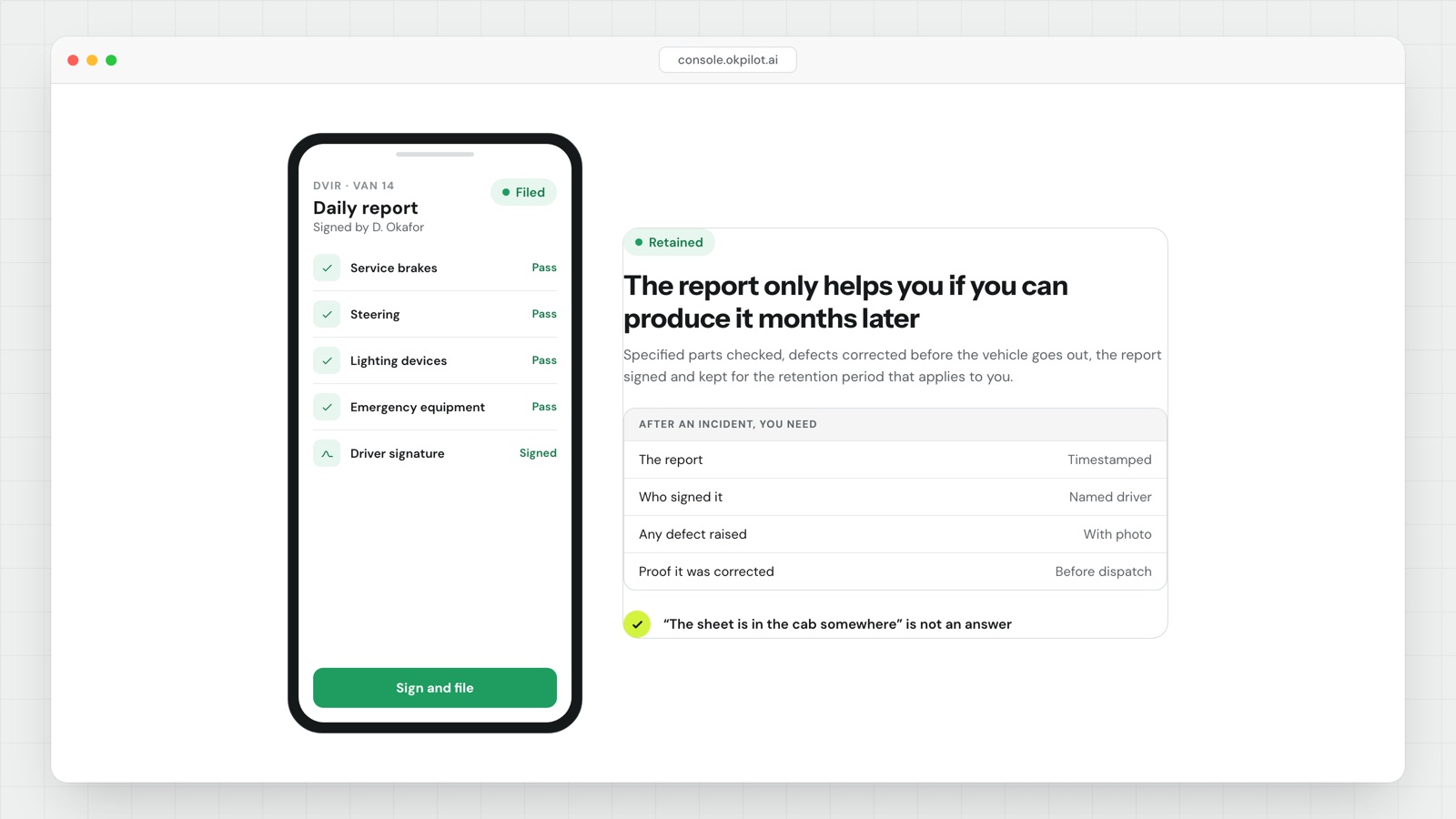
Driver vehicle inspection report requirements come from 49 CFR 396.11: the report covers a named list of vehicle parts, the driver signs it, any defect likely to affect safe operation must be repaired before the vehicle is operated again, and the carrier keeps the report for three months from the date it was prepared.
- The parts named in 396.11 are service brakes including trailer brake connections, parking (hand) brake, steering mechanism, lighting devices and reflectors, tires, horn, windshield wipers, rear vision mirrors, coupling devices, wheels and rims, and emergency equipment.
- For property-carrying commercial vehicles, a report is required when the driver finds or is told about a defect. A "no defects found" report is not federally required for these vehicles.
- For passenger-carrying commercial vehicles, a report is required at the end of each day's work on each vehicle, defects or not.
- Where defects are listed, the carrier or its agent must certify that the repair was made or that repair is unnecessary, and sign. The next driver reviews and signs that report before driving.
- Three months is the DVIR clock only. The annual (periodic) inspection report is kept fourteen months under part 396; maintenance records run one year plus six months after the vehicle leaves your control under 396.3.
- These are the federal rules for commercial motor vehicles in interstate commerce. Intrastate fleets, light-vehicle fleets and operations outside the United States sit under different requirements.
Driver vehicle inspection report requirements, part by part
The list of parts 49 CFR 396.11 names is eleven items long, shorter than most company forms. Adding your own is allowed and usually sensible: fluid levels, belts and hoses, load securement, air leak-down. Adding thirty is not. Every line is a line a driver ticks at 5am in the dark, and a form long enough to be tiresome gets pencil-whipped. A pencil-whipped DVIR is worse than none, because now you hold a signed document saying the brakes were fine.
Two neighboring rules get confused with this one. 49 CFR 392.7 says a driver must not operate the vehicle unless satisfied that broadly the same list of parts is in good working order — a duty to look, not a paperwork requirement. 49 CFR 396.13 says that before driving, the driver must review the last inspection report if one was prepared, and must sign it if defects were noted.
So: the pre-trip is the duty to look. The DVIR is the duty to write down what you found, in the circumstances the rule specifies.
Who files one, and the repair chain
Since the 2014 amendment to 396.11, a driver of a property-carrying commercial motor vehicle only has to prepare a report when a defect or deficiency is found or reported. The daily "no defects" DVIR is not a federal requirement for these vehicles. Many carriers still collect one anyway; that is company policy, not federal obligation, and worth knowing which you are enforcing.
Passenger-carrying commercial motor vehicles are different: a report is required at the completion of each day's work on each vehicle operated, whether or not anything was wrong.
Whenever a report lists defects, the chain is four steps:
- The driver signs the report.
- Defects likely to affect the safe operation of the vehicle must be repaired before the vehicle is operated again.
- The motor carrier or its agent certifies on the report that the repair was made, or that repair is unnecessary, and signs.
- The next driver reviews that report and signs it.
Step two is the point of the whole rule, and the step an audit tests. A report listing a brake defect, no repair certification, and dispatch records showing the vehicle ran the next morning is a finding you cannot talk your way out of.
Retention is three months, not forever
Retention under 396.11 is three months from the date the report was prepared, covering the original report together with the certification of repairs.
| Record | Retention | Source |
|---|---|---|
| DVIR and repair certification | 3 months | 396.11 |
| Annual (periodic) inspection report | 14 months | Periodic inspection rules in part 396 |
| Systematic maintenance and repair records | 1 year in your control, plus 6 months after it leaves | 396.3 |
Keeping DVIRs longer than three months is allowed and costs nothing once they are digital. Being unable to produce last month's quickly is the real exposure. "We have them, in a binder in the Dalton yard" is not production.
One honest caveat on all of the above: these are the federal rules for commercial motor vehicles in interstate commerce. Intrastate-only fleets sit under a state's own version of the FMCSRs, and the variations are real. In Canada, trip inspections fall under National Safety Code Standard 13 and the provinces, with different schedules and retention. If your vehicles sit under the CMV weight threshold and carry no hazardous materials, part 396 may not apply at all, which makes your inspection program an insurance decision rather than a compliance one. Check your jurisdiction and fleet class before you design a form, and have your safety director or attorney sign it off. No vendor can tell you your form is compliant.
A twelve-item walkaround that covers the rule
A sequence, not a list to read off a clipboard. It starts in the cab and goes once round the vehicle, so nothing gets skipped by jumping about.
- Previous report. Present? If it listed defects, is the repair certified and signed? If not, the vehicle does not move.
- Horn and wipers. Sound the horn. One dry sweep, then with washer fluid. Blade rubber for splits.
- Mirrors and glass. Both rear vision mirrors secure, clean, adjusted. Cracks in the swept area.
- Brakes at the pedal and the gauge. Service brake feel, air build-up and warning devices to your procedure, parking brake holding against a gentle pull.
- Steering. Free play at the wheel, no binding, no weep at the box or lines.
- Lights, walked. Both beams, markers, clearance, signals both sides, brake lights, hazards — walk behind the vehicle rather than trusting a reflection in a wall.
- Reflectors and conspicuity tape. Present, unbroken, not painted over or caked in dirt.
- Front tires. Tread depth, sidewall damage, inflation by gauge not by boot, valve stems and caps.
- Front wheels and rims. Cracks, bent flanges, loose or missing lug nuts, rust streaks running off a stud — that means a nut has been working loose.
- Coupling devices. Fifth wheel locked, kingpin seated, jaws closed, safety latch engaged, lines not chafing, trailer brake connections leak-free.
- Rear tires, wheels and rims. Same checks, including inner duals, which is where flats hide.
- Emergency equipment. Extinguisher charged and secured, spare fuses as applicable, complete set of warning devices. Triangles get used at a roadside and never replaced.
Anything on items 2 through 12 likely to affect safe operation stops the vehicle until it is repaired and certified. Anything not safety-critical still belongs on the report, because the second time the same item appears you have a pattern rather than a complaint.
The handoff is the part paper gets wrong
The compliance half of a DVIR program is settled by the rule. The operational half comes down to two things paper is bad at.
Evidence is the first. A ticked box proves nothing about whether anybody looked at the tire; a timestamped photo attached to the item does.
The handoff is the second, and where the quiet failure lives. A defect is reported Friday evening, the repair happens Saturday, nobody certifies it in writing, and the Monday driver signs a form saying the vehicle is fine. You will not notice until an audit or a crash.
That handoff is what software is genuinely for. Inspection management software that blocks dispatch on an open safety defect and keeps the signed record retrievable for the full three months removes both failure modes paper creates. It does not make the inspection happen properly — a driver who does not walk the vehicle will not start because the form moved to a phone. For keeping the daily check short enough that drivers do it, the pre-trip inspection app write-up covers form design rather than regulation.
This week: pull your last ninety days of reports, and for every one that listed a defect, check that a signed repair certification exists and that the vehicle stayed put until it did. That is the question an auditor asks first.
See OkPilot running your own operation
A live walkthrough with a real person, configured to your jobs on the call. About ten minutes. Setup takes around 48 hours.