Why furniture delivery fails at the door, not on the road
In short
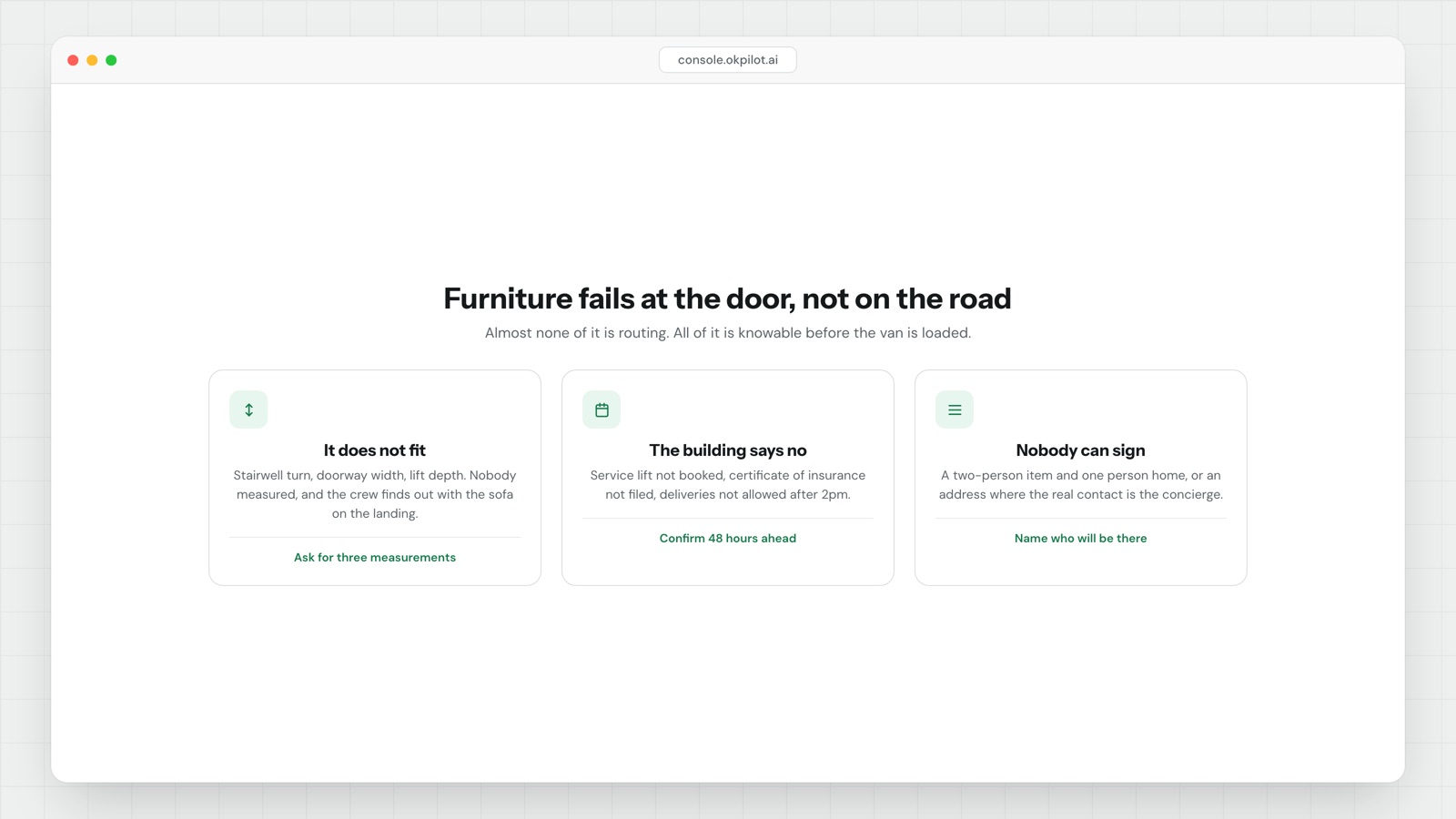
Furniture delivery fails at the door far more often than it fails on the road. The van arrives on time and the sofa will not turn on the landing, the goods lift is booked out, or the building wanted an insurance certificate filed two days ago. A pre-delivery survey catches most of it.
- Three measurements decide most fit questions, and almost nobody collects all three:
Will it fit?
Take the item's two shortest packaged dimensions,
then compare against:
  1. narrowest doorway, frame to frame (not the door leaf)
  2. narrowest turn on the route: stairwell, landing, corner
  3. lowest ceiling or soffit above that turn
Less than 50mm of margin on any of the three
= survey it before you book it.- Building admin is a lead-time problem, not a day-of problem. A certificate of insurance, a goods lift booking, a loading dock window and concierge notice each have their own notice period, and you have to ask what it is.
- A failed attempt costs you two slots, not one: the wasted visit and the redelivery you now cannot sell to anyone else.
- White glove home delivery in the last mile is mostly dwell time. Minutes at the door, on the stairs and in the room dominate the job, not minutes driving.
- There is no credible published benchmark for furniture access failure rates. Tag every failure with a reason code and you will have your own number inside a month.
Why furniture delivery fails: the five things that actually go wrong
Pull your last twenty failed furniture jobs and read the notes. The pattern is nearly always one of five things, and routing is not on the list.
1. It does not fit. The classic is a three-seat sofa that clears the front door and the hallway, then will not make the turn onto the first landing because the ceiling there is too low to stand it on end. The driveway was never the problem.
2. The access route was never checked. Lift out of service. A side gate too narrow for a packaged wardrobe. Forty metres from the nearest legal parking to the door, carrying a mattress in the rain. All knowable in advance, none of it asked.
3. The building said no. Managed blocks run their own rules: deliveries only between 10:00 and 16:00, goods lift must be booked, padding fitted in the lift car, a certificate of insurance naming the building on file before anyone is let in. The crew is at reception and reception is correct to turn them away.
4. Nobody competent was home. Somebody has to decide which wall the thing goes against, and sign for it. A neighbour cannot.
5. The crew is accused of damage. Different problem, same outcome: an unresolved job and a credit note.
Four of those five are access and paperwork. Getting to the address is solved and getting inside is not, and furniture is the clearest case: the item is large, heavy, expensive and cannot be left on a step.
The pre-delivery survey, question by question
Ask these before the job is scheduled, not the morning of. On big-ticket items, ask them while the order is still being placed, when the customer is motivated to answer.
Measurements
- Front door opening, frame to frame, in millimetres.
- Any narrower doorway on the route to the room.
- The narrowest turn — stairwell width, landing depth, hallway corner.
- Ceiling height above that turn, and above any staircase.
- Any fixed obstruction: banister, radiator, meter cupboard, low pendant light.
The route in
- Floor number, and is there a lift that fits the item standing or lying down?
- If there is a lift: does it need booking, and how far ahead?
- Stairs: how many flights, and are they straight or do they turn?
- Distance from where a long vehicle can legally stop to the door.
- Is there a step, a gravel run, a locked gate, a code, a key safe?
The building
- Is there a delivery window the building enforces, and a loading bay to book?
- Does the building require a certificate of insurance, and in whose name, and by when?
- Who do we ring on arrival — concierge, facilities, site manager — and on what number?
The handover
- Which room, and against which wall?
- Who will be present and able to sign, and on which phone number?
- Is the old item being taken away? Is it disconnected, emptied, dismantled?
- Will packaging be removed, and does the building have anywhere to put it?
Seventeen questions sounds like a lot until you price one failed attempt on a wardrobe. Most are a single tap, and they only need asking once per address: store them and the next delivery to that block is survey-free.
The survey is not paperwork. It is the difference between a job you can plan and a job you are hoping about.
The paperwork has a lead time, and that is what catches people
The fit questions get asked occasionally. The administrative ones almost never do, and they fail harder, because you cannot solve them from the kerb.
A certificate of insurance is the worst of them. The managing agent wants a COI naming the building as an additional insured party, your broker needs a day or two to issue it, and the building wants it on file before the booking is confirmed. Find that out when the crew reaches reception and the earliest redelivery is next week. Goods lift bookings behave the same way: the diary fills, and a slot is a slot.
So treat these as blocking conditions on the schedule, not as notes. The job should not be bookable into a slot until the fields are filled:
- COI required? If yes, requested on date, received on date.
- Lift booking required? If yes, booked for window.
- Building delivery window: from and to.
- Site contact: name and number.
Any blank, and the job sits in a pre-booking state where somebody owns chasing it. That is less satisfying than a full route for tomorrow, and it is a great deal cheaper than a crew standing in a lobby.
What one failed furniture delivery actually costs
Work it out once for your own operation and the survey stops being a debate.
Cost of one failed attempt =
    crew hours on the wasted visit x loaded crew cost
  + the delivery slot you could not sell to anyone else
  + handling the item back into the warehouse and out again
  + storage days until the redelivery
  + any goodwill discount or refund to keep the order
  + the share of these customers who cancel outright
Two of those lines are usually missing from the internal estimate. The lost slot is real revenue, not a hypothetical, and the cancellation share is the expensive one, because the margin on a large furniture order is worth far more than a second van.
Use your own figures rather than an industry report's: take last quarter's failed attempts, split them by reason code, and multiply. Which needs the crews recording a reason code at all, rather than typing "couldn't deliver" into a free-text box.
Make the answers travel with the job
A survey that lives in a spreadsheet, an email thread, or a salesperson's head is not a survey. The crew needs it on the phone, at the door, in the order they will use it: park here, this code, ring this person, the turn is tight, the room is first on the left.
The same applies to what comes back. For furniture, proof of delivery has to be more than a signature: photos of the item in position, photos of the hallway and skirting before the crew starts work, and a named signature with a timestamp. The before photos are what settle a damage claim three weeks later, and they cost ten seconds.
OkPilot carries the access answers onto the field app and the proof back off it, and the office can type the instruction — hold this job until the insurance certificate lands — with a person approving before anything moves. Mechanics on the delivery management page.
See OkPilot running your own operation
A live walkthrough with a real person, configured to your jobs on the call. About ten minutes. Setup takes around 48 hours.